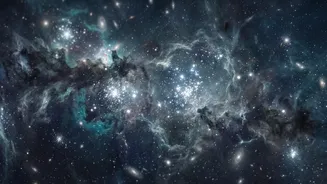


For decades, we’ve understood the universe to be about 13.8 billion years old. Now, a new model from researchers at the University of Ottawa is challenging that cornerstone of cosmology, suggesting the universe is actually 26.7 billion years old.
Our Standard Cosmic Story
The prevailing
theory of the universe is known as the Lambda-CDM model (ΛCDM). It has been the standard for decades, successfully explaining many large-scale observations, from the cosmic microwave background (the faint afterglow of the Big Bang) to the distribution of galaxies. This model is built on the idea that the universe began with the Big Bang and has been expanding ever since. Astronomers measure this expansion by observing redshift—the way light from distant galaxies stretches into redder wavelengths as they move away from us. By measuring this redshift and extrapolating backward, scientists calculated that everything began around 13.8 billion years ago. The model also relies on two mysterious components: dark matter, an unseen substance providing extra gravitational pull, and dark energy, a force driving the accelerated expansion of the universe.
Puzzles in the Primordial Darkness
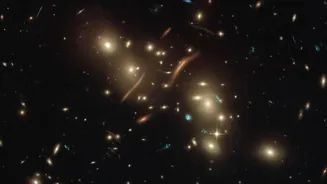
While the Lambda-CDM model has been successful, recent discoveries have created what some call the ‘impossible early galaxy problem’. The James Webb Space Telescope (JWST) has spotted galaxies in the very early universe that are surprisingly massive and mature. According to the standard 13.8-billion-year timeline, these galaxies existed just a few hundred million years after the Big Bang, which shouldn't have been enough time for them to grow so large and structured. It's like finding a fully grown oak tree in a field where you only planted an acorn a week ago. This has prompted some scientists to question whether the standard model is missing a piece of the puzzle.
A New Theory: Tired Light and Shifting Constants
Enter Rajendra Gupta, an adjunct professor of physics at the University of Ottawa. He proposes an alternative model called CCC+TL, which stands for Covarying Coupling Constants plus Tired Light. This hybrid theory combines two ideas. The first is 'tired light', a century-old concept suggesting that photons (particles of light) might lose energy as they travel across billions of light-years, causing them to appear redder. This would mean that not all of the observed redshift is due to cosmic expansion. The second part, 'covarying coupling constants', proposes that the fundamental forces of nature, which govern how particles interact, might change over time. By blending these ideas, Gupta's model reinterprets redshift as a hybrid phenomenon, not purely a measure of expansion.
A Universe Twice as Old
By applying the CCC+TL model, the cosmic timeline stretches significantly. The new calculation places the age of the universe at 26.7 billion years, almost double the current estimate. This expanded timeframe solves the 'impossible early galaxy problem' at a stroke. In this model, the period known as 'Cosmic Dawn', when the first stars and galaxies began to form, would have occurred much later, giving those early, massive galaxies billions of years to develop, rather than just a few hundred million. Furthermore, Gupta's model suggests that the effects we attribute to dark matter and dark energy might just be the result of these changing physical constants, potentially eliminating the need for these elusive substances altogether.
What Happens Next?
The CCC+TL model is a provocative challenge to mainstream cosmology, but it is not yet a replacement for the Lambda-CDM model. Gupta and his colleagues have tested their framework against several key cosmological observations, including the abundance of light elements created after the Big Bang and the rotation of galaxies, and found that it holds up. However, the scientific community prizes verification and replication. This new model will need to undergo intense scrutiny and be tested against a wider range of data before it can be considered a viable alternative. It represents a fascinating new possibility, but for now, it remains a hypothesis awaiting further proof. Other upcoming JWST observation programs may provide the data needed to further test this new theory against the standard model.