


The Challenge of a Fiery Re-entry
Any object entering Earth's atmosphere from space is travelling at incredible speeds, often faster than 18,000 miles per hour. At this velocity, the friction created by air molecules generates immense heat, reaching temperatures that can easily melt metal.
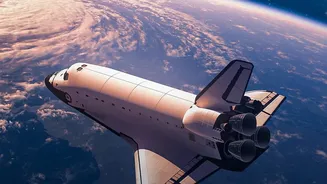
This process, known as atmospheric entry, requires a robust thermal protection system (TPS) to prevent the spacecraft and its precious cargo from burning up. For decades, the solution has been rigid heat shields, like the tiles on the Space Shuttle or the ablative shields on the Apollo capsules, which burn away in a controlled manner to dissipate heat. However, these traditional shields have a major limitation: their size is constrained by the rocket fairing that carries them into space. This creates a bottleneck, limiting the size and mass of payloads we can land on other planets or return to Earth.
An Inflated Sense of Safety
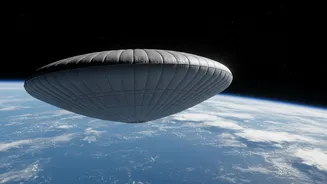
Enter the inflatable heat shield, officially known as a Hypersonic Inflatable Aerodynamic Decelerator, or HIAD. The concept is elegantly simple: what if a heat shield could be packed into a small volume for launch and then inflated to a much larger size just before entering the atmosphere? A larger shield creates more drag, acting like a giant brake to slow the spacecraft down much higher in the atmosphere where the air is thinner and heating is less intense. This allows the vehicle to decelerate more gently and effectively. NASA has been developing and testing this technology for over a decade, with projects like the Inflatable Re-entry Vehicle Experiment (IRVE) and the more recent Low-Earth Orbit Flight Test of an Inflatable Decelerator (LOFTID). The successful LOFTID test in late 2022 saw a 6-meter (about 20-foot) inflatable shield survive a blistering re-entry, proving the concept's viability.
More Than Just a Balloon
Describing it as a mere 'inflatable' is an understatement. A HIAD is a marvel of materials science. The structure is formed by a series of stacked inflatable rings, or tori, made from a synthetic polymer that is, by weight, ten times stronger than steel. This provides the rigid shape needed to withstand hypersonic forces. The all-important thermal protection comes from a flexible outer layer made of a woven ceramic fabric, silicon carbide, which can endure extreme temperatures. Beneath this outer fabric are layers of high-tech insulation to prevent heat from reaching the inflatable structure and the payload within. The entire assembly is designed to be folded and vacuum-packed for launch, then inflated in space using a gas like nitrogen.
The Game-Changing Advantages
The benefits of inflatable heat shields are transformative. First, because they are lightweight and packable, they solve the size limitation of rigid shields. A HIAD can be deployed to a diameter much larger than any rocket fairing could accommodate if it were a single solid piece. This expanded surface area is the key to landing heavier payloads, which is crucial for future missions. For a planet like Mars, with its thin atmosphere, a larger decelerator is essential for slowing down the massive habitats and supply craft needed for human exploration. It also enables landings at higher altitudes, opening up new, scientifically interesting regions on Mars that were previously inaccessible because there wasn't enough atmosphere at lower elevations to slow spacecraft with smaller shields.
An Inflatable Future in Space
The successful demonstration of HIAD technology has opened the door to a new era of space exploration. NASA and its partners are now looking to apply this technology to a wide range of missions. This includes returning large rocket components for reuse, which could drastically lower launch costs. For planetary science, it could enable missions to Venus and Saturn's moon Titan, both of which have thick atmospheres where a large decelerator would be highly effective. Perhaps most excitingly, inflatable heat shields are considered an enabling technology for sending humans to Mars. They provide a practical solution for landing the heavy cargo and crewed vehicles required to establish a sustained presence on another world. This simple yet brilliant idea of an inflatable shield is paving the way for bigger, bolder, and more ambitious journeys across our solar system.