



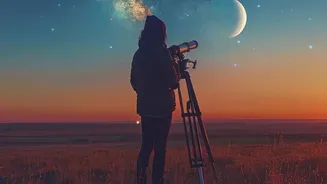

Your Window to the Cosmos
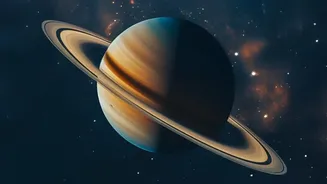
First, let's manage expectations. While you don't need a professional telescope, the naked eye alone isn't quite enough to resolve Saturn's famous rings. To the unaided eye, Saturn appears as a bright, yellowish, and steady point of light, about as bright as the most
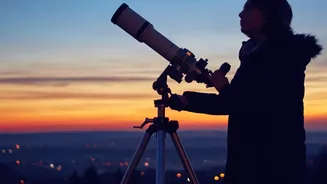
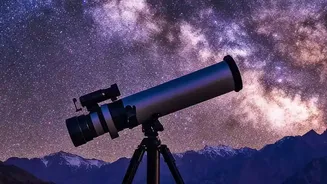
brilliant stars. A good pair of binoculars (10x50 or higher) held very steady might show it as a tiny, slightly elongated oval, hinting at something more, and will certainly reveal its brightest moon, Titan. But to truly see the rings as separate from the planet, you'll need a telescope. The good news is that even an entry-level telescope can do the job. A quality refractor with a 70-90mm aperture or a reflector with a 114-130mm aperture will clearly show the rings under good conditions. These instruments are widely available in India and can be a fantastic gateway into the hobby of amateur astronomy.
When and Where to Look
Timing is crucial for a successful Saturn viewing. The best time to observe any outer planet is during its 'opposition', an event when Earth passes directly between the planet and the Sun. This makes the planet appear bigger and brighter, and it remains visible for the entire night, rising in the east as the sun sets in the west. For skywatchers in India, Saturn's opposition in 2026 occurs on October 4. Around this date, the planet will be at its closest to Earth for the year, making it an ideal target. Specifically, on October 4, 2026, Saturn will rise around 6:11 PM IST, reach its highest point in the sky just after midnight, and set around 6:23 AM the next morning, offering a generous 12-hour viewing window, weather permitting. To find it, look for a bright, non-twinkling 'star' along the ecliptic—the same path the Sun and Moon travel across the sky. Numerous smartphone apps can help you pinpoint its exact location from your city.
Setting the Stage for Success
The 'clear skies' part of the equation is non-negotiable. Your biggest enemy is light pollution from cities, which can wash out all but the brightest celestial objects. If possible, travel to a location with darker skies, away from streetlights and buildings. Even a local park can be a significant improvement over a brightly lit balcony. Another key factor is 'seeing', a term astronomers use to describe the stability of the atmosphere. On nights of bad seeing, the air is turbulent, causing the image in your telescope to ripple and blur. On nights of good seeing, the air is steady, and details will appear much sharper. Before you even start observing, allow your telescope to adjust to the outside temperature for at least 30 minutes to an hour. This prevents warm air currents inside the telescope tube from distorting the view.
The Art of Patient Observation
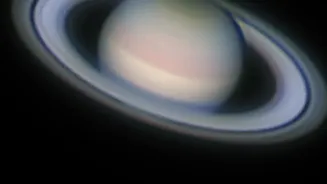
Once you have Saturn in your eyepiece, the final ingredient is patience. Don't expect a crystal-clear, Hubble-like image instantly. Your eyes need time to adapt to the dark and to the subtle details in the eyepiece. Keep both eyes open to avoid strain. What you will likely see through a small telescope is a small but distinct orb, clearly encircled by its rings. At a magnification of around 50x to 150x, you should be able to make out the gap between the planet and the rings. Look closely during moments of atmospheric stillness. You might be able to spot the Cassini Division, a dark gap that splits the rings into an outer 'A' ring and an inner, brighter 'B' ring. With a slightly larger amateur telescope (6 to 8 inches), you might also glimpse the faint, pale cloud bands on the planet itself and a few of its brightest moons, like Rhea and Dione, appearing as tiny star-like points of light near the planet.