



An Ocean of Icy Debris
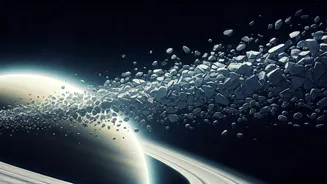
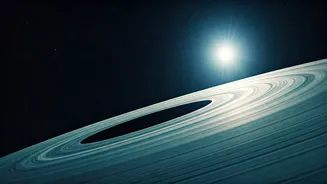
When you look at Saturn through a telescope, its rings appear as solid, elegant structures. The reality is far more granular and fascinating. The rings are composed almost entirely of water ice—about 99.9% pure. The remaining fraction is a mixture of rocky
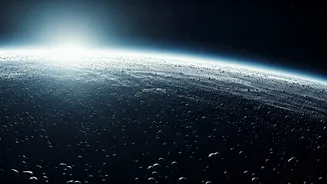
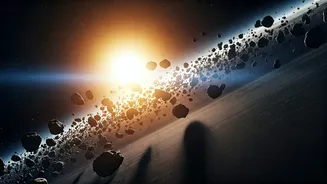
material and dust, likely contaminants from meteoroid impacts over millions of years. These aren't uniform particles, either. They range in size from microscopic dust specks, smaller than a grain of sand, to colossal chunks of ice as large as a house or a bus. Imagine a vast, flat cloud of hailstones, snow, and icebergs all orbiting a planet at incredible speeds, and you're getting close to the truth of what Saturn's rings really are.
Wider Than a Planet, Thinner Than Paper
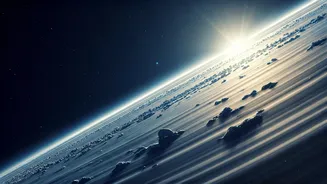
The scale of the ring system is almost impossible to comprehend. The main rings stretch up to 282,000 kilometres in diameter—wide enough to fit the distance between the Earth and the Moon. Yet, for all their immense breadth, they are astonishingly thin. In most places, the main rings are only about 10 metres thick. This extreme proportion makes them the thinnest known structure in the solar system. To put it in perspective, if you were to build a scale model of the rings that was the size of a large city, its thickness would be less than that of a single sheet of paper. This incredible thinness is a result of the constant collisions between particles, which tend to cancel out any vertical motion, forcing everything into a single, flat plane.
The Sculptors: Shepherd Moons
So, what keeps this chaotic blizzard of ice organised into such distinct, sharp-edged rings? The answer lies with Saturn's many moons. Dozens of tiny 'shepherd moons' orbit within and around the ring system, their gravitational influence acting like cosmic sculptors. Two of the most famous are Prometheus and Pandora, which orbit on either side of the thin F ring. Their combined gravity herds the stray ice particles, preventing them from drifting away and keeping the ring's edge razor-sharp. Other, smaller moonlets embedded within the rings create mesmerising patterns. They clear gaps in the material around them, generating propeller-like structures that were observed in stunning detail by NASA's Cassini spacecraft. These moons are the architects of the rings' iconic structure, creating the famous gaps, like the Cassini Division, that separate the A and B rings.
A Dynamic, Ever-Changing System
The rings are anything but static. They are a dynamic environment of constant change. Cassini observed strange, ghostly 'spokes' appearing and disappearing on the B ring—dark or bright radial features that rotate along with the ring. These are believed to be caused by tiny, electrically charged dust particles levitating above the main ring plane due to Saturn's magnetic field. The rings also feature waves and ripples, some towering kilometres high, created by the gravitational pull of passing moons. These are essentially density waves, similar to a traffic jam on a motorway, where particles bunch up and then spread out. This constant motion, collision, and gravitational nudging mean the rings are always evolving.
A Cosmic Crime Scene?
One of the biggest mysteries is where the rings came from. For a long time, scientists thought they formed along with Saturn over 4.5 billion years ago. However, data from the Cassini mission revealed the rings are surprisingly pristine and bright, suggesting they are much younger—perhaps only 10 to 100 million years old. This has led to the leading theory that the rings are the remnants of a cosmic catastrophe. It's possible that a large, icy moon strayed too close to Saturn and was ripped apart by the planet's immense gravity. Another possibility is that a passing comet or a collision between two moons created the debris field that eventually settled into the ring system we see today. In this sense, the rings might be the beautiful, glittering evidence of a long-ago act of celestial violence.