




How Microwaves Actually Heat Food
First, let's clear up a common myth. Microwaves don't cook food from the "inside out". Instead, a microwave oven floods its chamber with high-frequency electromagnetic waves. These waves are specifically tuned to agitate one molecule in particular: water.
Water molecules have a positive and a negative end, making them tiny dipoles. The rapidly flipping electric field inside the oven causes these water molecules to spin back and forth billions of time per second. This frantic molecular dance creates friction, and that friction generates the heat that cooks your food. Foods with higher water content, therefore, tend to heat up much more quickly than drier foods.
The Problem of Standing Waves
If the oven is full of waves, why isn't the heating perfectly even? Because the waves don't just pass through the food; they bounce off the metal walls of the oven. As these reflected waves run into incoming waves, they interfere with each other, creating a fixed pattern of high and low energy zones known as a "standing wave". Think of it like two people wiggling a skipping rope. In some spots the rope moves wildly (antinodes), and in other spots, it barely moves at all (nodes). In your microwave, the antinodes are hot spots where molecules are vigorously agitated, while the nodes are cold spots that receive very little energy. Your food is essentially sitting in a landscape of invisible peaks and valleys of energy.
Why a Turntable Isn't a Perfect Fix
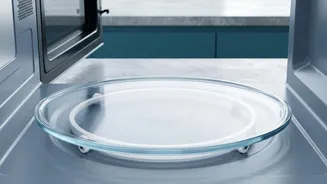
The rotating turntable was invented specifically to combat this issue. The idea is simple: by moving the food through the different hot and cold zones, the heating should average out. And it does help, but it's not a foolproof solution. Food in the very center of the plate moves very little, while food on the outer edge travels a much greater distance. This is why the center of your bowl of soup can remain lukewarm while the edges are bubbling. Furthermore, a large or square plate may not rotate smoothly, leaving some corners to linger in cold spots while other parts get blasted in hot spots. Some modern ovens use a hidden metal fan, called a mode stirrer, to scatter the waves instead of rotating the food, but the goal is the same: to even out the energy distribution.
It's Not Just the Oven, It's the Food
The microwave itself is only half the story. The composition and shape of your food play a huge role in how it heats. As mentioned, areas with more water heat faster than drier parts, which is why the filling of a pie might become molten while the crust is still cool. The density and thickness of food also matter. Microwaves can only penetrate so far into dense items. In a thick piece of food like a potato or a dense casserole, the outer layers heat directly from the waves, but the very center has to wait for heat to travel inward through simple conduction, just like in a conventional oven. This is why you often get a cooked exterior and a cool center.
Your Guide to Perfectly Even Heating
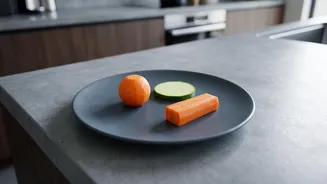
Now that you understand the science, you can outsmart your microwave. The most effective strategy is to arrange your food in a ring on the plate, leaving the center empty. This donut shape ensures no part of your food sits in the stagnant central zone. You should also stir your food halfway through the cooking time, which manually redistributes heat from the hot spots to the cold spots. For solid foods, try flipping them over or rearranging them. Covering your food with a microwave-safe lid or a damp paper towel traps steam, which helps to keep food moist and distribute heat more evenly. Finally, let your food stand for a minute or two after the timer goes off. This allows the heat to continue conducting from the hotter parts to the colder parts, resulting in a more uniform temperature.