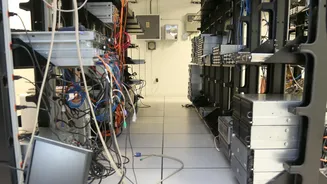







India's digital economy is undergoing a colossal expansion, and behind every click, stream, and transaction lies a data centre. A recent Crisil forecast says this backbone infrastructure will grow five-fold by 2030, a surge demanding immense investment.
The Scale of the Digital Gold Rush
According to a new report from Crisil Ratings, India's data centre capacity is on track for an unprecedented expansion, projected to quintuple from around 1.7 GW in 2024 to 7.5 GW by 2030. This boom is expected to attract over ₹3 trillion in investments over the next few years. This isn't just gradual growth; it's a structural shift. India, which currently accounts for a significant portion of global data consumption but a smaller fraction of data centre capacity, is rapidly closing the gap. This explosive growth is turning the nation into one of the fastest-growing data centre markets in the Asia-Pacific region, driven by a perfect storm of technological advancement and economic ambition.
What's Fuelling the Five-Fold Surge?
Three main forces are driving this phenomenal growth: the rise of Generative AI, enterprise digitalisation, and soaring data consumption. The computational demands of AI and machine learning workloads require high-density infrastructure on a scale never seen before. An AI-powered query, for instance, consumes significantly more energy than a simple web search, multiplying the need for powerful data processing facilities. Simultaneously, Indian enterprises are rapidly migrating their operations to the cloud, and the country's over one billion internet users are consuming more data than ever through streaming, online gaming, and digital payments. This immense demand is attracting global hyperscalers—large cloud service providers like Amazon, Google, and Microsoft—who are committing billions to build massive data campuses across the country.
The Power Conundrum
This expansion comes with a critical challenge: power. Data centres are incredibly energy-intensive. The projected 7.5 GW capacity will place enormous strain on the electricity grid. Crisil notes that nearly three quarters of this new capacity is concentrated in hubs like Visakhapatnam, Mumbai, and Hyderabad. In these cities, the power demand from data centres could equal a substantial fraction of their entire current peak electricity needs, potentially as high as 60% in some cases. Securing timely, reliable, and high-voltage power connections is no longer just an operational detail; it has become the most critical bottleneck for the industry. Delays in augmenting transmission infrastructure could lead to significant commissioning delays and cost overruns for these multi crore projects.
The Push for Green and Sustainable Power
With great power comes great responsibility for the environment. The industry is acutely aware that its massive energy consumption carries a significant carbon footprint. Consequently, there is a strong push towards powering these digital factories with renewable energy. India's competitive solar tariffs and vast potential for green energy are a major draw for international hyperscalers, who have their own ambitious sustainability goals. Developers are increasingly focused on building large campuses that can be powered by renewable sources. This transition is not just about environmental compliance; it's a core competitive advantage. The ability to offer green powered data centres is becoming a key factor in attracting long term contracts from global tech giants.
The Major Players and the Road Ahead
The Indian data centre market is being shaped by domestic behemoths and global tech leaders. Conglomerates like Adani Group and Reliance are investing heavily, alongside established players like Sify, CtrlS, and Nxtra by Airtel. International firms such as Equinix, NTT, and ST Telemedia are also expanding their footprint, often through partnerships and acquisitions. While the opportunity is immense, the path to 2030 requires careful navigation. Beyond securing power, the industry must manage risks related to customer concentration, as a few large hyperscalers are expected to lease the majority of capacity. Furthermore, as technology evolves, existing facilities will need upgrades to handle next generation AI workloads, requiring further investment in advanced cooling and power density solutions.