

The Dust Dilemma
Exploring Mars is a multi-billion dollar investment, and one of the greatest threats to that investment is deceptively simple: dust. The fine, reddish grit that covers the planet is electrostatically charged, meaning it clings to surfaces like rover solar
panels. Over time, this accumulation blocks sunlight and slowly starves a mission of its power. The NASA InSight lander, which provided unprecedented data on 'marsquakes', succumbed to this dusty fate in late 2022. Its solar arrays became so coated that they could no longer generate enough energy to operate, forcing the agency to retire an otherwise healthy machine. This wasn't a surprise. Mission planners have long known about the dust risk, but adding complex cleaning mechanisms like wipers or blowers adds weight and potential failure points, a difficult trade-off when launching hardware millions of kilometres through space.
An Unlikely Cleaning Service
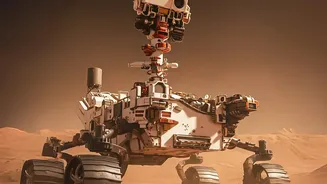
For years, Mars exploration benefited from a lucky phenomenon known as 'cleaning events'. NASA's twin rovers, Spirit and Opportunity, were initially designed for 90-day missions, with the expectation that their panels would quickly become too dusty to function. Instead, they operated for years—in Opportunity's case, for nearly 15 years. Their secret was the Martian weather itself. Periodically, swirling columns of air and dust, known as dust devils, would pass directly over the rovers. These whirlwinds, while not powerful enough to harm the hardware, were strong enough to blow the accumulated dust off the solar panels, restoring their power to near-perfect levels. One event in 2005 boosted Spirit's power generation by 50% in a single day. These events were a welcome, but entirely unpredictable, lifeline.
From Luck to Strategy
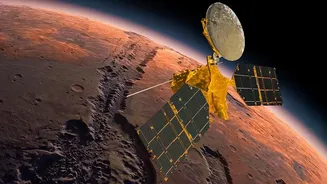
Relying on random chance is not a viable long-term strategy for exploring another planet. That's why scientists are now systematically hunting dust devils from orbit. Using powerful cameras like the High-Resolution Imaging Science Experiment (HiRISE) aboard NASA's Mars Reconnaissance Orbiter (MRO), researchers can spot the distinctive, snaking tracks that dust devils leave behind as they scour the bright surface dust away to reveal the darker ground underneath. These tracks can last for months, allowing scientists to build up a comprehensive map of dust devil activity across the planet. By studying where and how often these tracks appear and fade, they can calculate the rate of dust deposition and identify regional 'hot spots' for dust devil formation. This turns a random weather event into a predictable, mappable environmental factor.
Forecasting the Martian Weather
The data gathered by orbiters like the MRO and Europe's Trace Gas Orbiter is crucial for creating the first reliable weather forecasts for dust devils on Mars. Scientists are building models to understand why these whirlwinds form in some areas and not others, and what seasonal triggers might influence them. The goal is to predict where and when cleaning events are most likely to occur. This has profound implications for future missions. Instead of landing in a seemingly safe, flat area that turns out to be a dust trap—as was the case for InSight—mission planners could strategically target locations with a high probability of beneficial wind activity. This approach represents a monumental shift from passively hoping for good weather to actively using environmental intelligence to enhance mission longevity and return on investment.
Designing for a Dusty World
This research also directly informs the engineering of the next generation of Martian explorers. Understanding the physics of dust devils could lead to new rover designs that are better at taking advantage of them. The European Space Agency, for example, is investigating concepts like splitting large solar panels into smaller, convex tiles. The idea is that the gaps between tiles could make it easier for wind to get underneath the dust and lift it away, increasing the efficiency of natural cleaning events. Other active solutions, like using electrostatic fields to repel charged dust particles, have also been developed and could become more attractive as power budgets for ambitious missions grow. For now, the nuclear-powered Curiosity and Perseverance rovers bypass the problem entirely, but solar remains a vital, lower-cost option for many missions—as long as we can master the dust.