



Why Sitting Causes Stiff Hips
When you sit for extended periods, your body adapts to that position. The muscles at the front of your hips, known as the hip flexors, remain in a shortened state. Over time, this can lead to chronic tightness and reduced flexibility. Meanwhile, the muscles on the opposite
side, your glutes, become inactive and weak from lack of use. This muscular imbalance—tight hip flexors and weak glutes—is a primary cause of the stiffness, poor posture, and even lower back pain many desk workers experience. Reduced circulation from staying in one position also contributes to that feeling of stiffness when you finally stand up. Regularly moving your hips through their full range of motion is crucial to counteracting these effects.
Kneeling Hip Flexor Stretch
This is one of the most effective stretches to lengthen the hip flexors that become tight from sitting. To perform it, kneel on your right knee, placing a cushion underneath for comfort if needed. Step your left foot forward so that your left leg forms a 90-degree angle, with your knee directly over your ankle. Keeping your torso upright, gently push your hips forward until you feel a comfortable stretch in the front of your right hip and thigh. Avoid arching your lower back; the movement should originate from the hips. Hold this position for 30 seconds, breathing deeply, before switching to the other side.
Glute Bridge
The glute bridge is excellent for 'waking up' the gluteal muscles that become inactive during long periods of sitting. Lie on your back with your knees bent, feet flat on the floor about hip-width apart, and your arms resting by your sides. Press through your heels to lift your hips off the floor until your body forms a straight line from your shoulders to your knees. Squeeze your glutes at the top of the movement and hold for a few seconds. Be careful not to over-extend and arch your back. Slowly lower your hips back to the starting position. Aim for 10 to 15 repetitions.
Seated Figure-Four Stretch
This stretch targets the deep glute muscles, including the piriformis, which can contribute to hip and sciatic-like discomfort. While sitting on a chair, cross your right ankle over your left knee, creating a 'figure four' shape. Sit up straight and gently press down on your right knee to deepen the stretch. For a more intense stretch, you can slowly lean your torso forward while maintaining a flat back. You should feel the stretch in your right glute and the outer part of your hip. Hold for 30 seconds, and then repeat on the other side. This is a discreet and easy stretch to do even while at your desk.
Leg Swings
Dynamic stretches like leg swings help improve mobility and increase blood flow to the hip joint. Stand and hold onto a wall or sturdy chair for support. Keeping your torso upright, swing one leg forward and backward in a controlled motion. Start with a small range of motion and gradually increase it as you feel more comfortable. Perform 15-20 swings, then switch legs. Next, turn to face the wall and swing your leg from side to side across the front of your body. These movements help to gently open up the hip joint in multiple directions.
Cat-Cow Pose
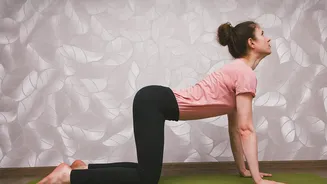
While often associated with spinal flexibility, the Cat-Cow pose also encourages gentle movement in the hips and pelvis. Start on your hands and knees in a tabletop position, with your wrists under your shoulders and your knees under your hips. As you inhale (Cow pose), drop your belly towards the floor, lift your chest and tailbone, and look forward. As you exhale (Cat pose), round your spine towards the ceiling, tuck your chin to your chest, and press the floor away. The tilting motion of the pelvis during this sequence helps to gently mobilize the hips and lower back, relieving tension built up from sitting.