



Mind the Moon
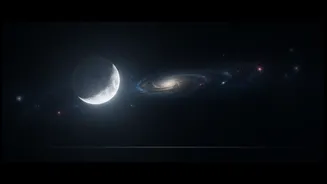
The moon, while beautiful, can be a stargazer's biggest rival. A bright full moon acts like a giant celestial lamp, casting so much light that it washes out the fainter, more distant stars. This is why seasoned astronomers often plan their deep-sky viewing
sessions around the new moon. During a new moon, our lunar neighbour is invisible in the night sky, creating the darkest possible conditions and allowing thousands more stars to become visible. If you can't wait for a new moon, even the nights following a crescent moon offer good viewing opportunities once the moon has set. Planning your stargazing around the lunar calendar is the first and most important step toward seeing the night sky in all its glory.
Seek True Darkness
Your second great challenge is artificial light. For a majority of the world's population, light pollution from cities and towns has erased the starry view our ancestors knew. The key is to escape this persistent glow. You can find prime stargazing spots by using online light pollution maps, which show areas with darker skies. These maps use a colour-coded system, often called the Bortle scale, to rate sky darkness from a light-drenched white zone (a city centre) to a pristine grey zone (a remote wilderness). You don’t have to travel for days; often, a short drive out of the city to a designated state or national park can make a world of difference. These International Dark-Sky Association-approved locations are protected areas known for their exceptional nightscapes.
Get Your Bearings
The night sky isn’t just a random scattering of lights; it’s a map. Understanding basic directions is crucial for navigating it. Knowing which way is north, south, east, and west helps you locate constellations, planets, and even meteor showers. In the Northern Hemisphere, the North Star, Polaris, is your most reliable anchor, as it sits almost directly above the North Pole. You can find it by using the two outer stars of the Big Dipper's 'cup' to point the way. Once you locate north, the rest of the sky becomes easier to navigate. For more detailed guidance, stargazing apps for your smartphone can use your device's compass and GPS to identify celestial objects in real-time. Many allow you to simply point your phone at the sky to see names of stars and constellations appear on your screen.
Timing Is Everything
Finally, great stargazing is a matter of patience and timing. First, your eyes need time to adjust. It takes about 20 to 30 minutes for your pupils to fully dilate and adapt to the dark, a process called dark adaptation. During this time, avoid looking at bright lights, especially your phone screen, as a single glance can reset your night vision. If you need light, use a red-light torch, which doesn't affect dark adaptation as severely. Time of year is also critical. Winter nights are longer and the cold air is often clearer and less hazy, making it what many astronomers call the 'observing season'. Summer, on the other hand, is the best time to see the core of our own galaxy, the Milky Way, arching across the sky. Paying attention to all four of these essentials will transform your experience from a simple glance upwards into a truly breathtaking cosmic journey.