

The Sun’s Enduring Fever
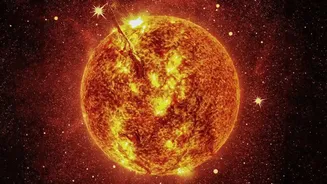
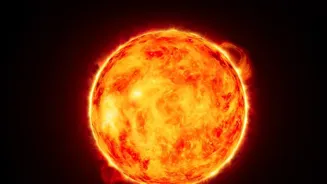
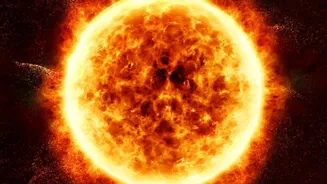
Imagine standing near a fire and finding that it gets dramatically hotter the further you walk away from it. This is precisely the dilemma scientists face with the sun. The visible surface, or photosphere, sizzles at around 5,500 degrees Celsius. But
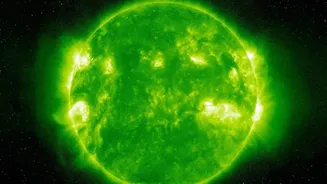
the corona, the sun’s ethereal outer atmosphere, reaches an astonishing one to two million degrees Celsius. This counter-intuitive phenomenon, known as the coronal heating problem, has baffled astrophysicists since the 1940s. Logically, the temperature should decrease with distance from the sun's core, its energy source. The fact that it doesn’t suggests that some unknown mechanism is actively pumping enormous amounts of energy upwards into the corona. Finding this mechanism has been a holy grail of solar physics, as it's key to understanding not just our star, but all stars.
A Whirlwind Discovery
In a major breakthrough, an international team of scientists has observed something entirely new on the sun's surface: tiny, swirling vortices of plasma. These whirlpool-like patterns were captured in the highest-resolution images ever taken of the sun, using the powerful Daniel K. Inouye Solar Telescope in Hawaii. The structures are incredibly small by solar standards, with some measuring just 20 kilometres across — an achievement likened to spotting a small coin from 180 kilometres away. These vortices, appearing like breaking ocean waves at the edges of bubbling solar granules, are the first direct confirmation of a phenomenon known as the Kelvin-Helmholtz instability on the sun. This effect occurs when two fluids, or in this case plasmas, flow past each other at different speeds, creating a spinning, unstable shear force.
Riding the Plasma Wave Upward
The discovery of these vortices is more than just a visual marvel; it provides a tangible mechanism for energy transport. The headline's "newly seen solar plasma wave" refers to these twisting motions. As these tiny whirlpools churn at the sun's surface, they are believed to twist and tangle the sun's magnetic field lines, much like coiling a spring. This process effectively loads energy into the magnetic field. Scientists theorise that this instability and twisting motion can generate waves that travel upwards along the magnetic field lines, carrying energy from the cooler photosphere into the super-heated corona. These disturbances, a type of magnetic wave known as Alfvén waves, have long been suspected to play a role in coronal heating, but directly observing their source has been a challenge until now.
Solving a Half-Century Mystery?
This discovery could be the missing link. The constant churning of countless tiny vortices across the sun's surface could provide a steady, continuous supply of energy needed to maintain the corona's extreme temperatures. The energy loaded into the magnetic field by these twisting motions can cascade upwards and dissipate as heat in the thin atmosphere of the corona. This process helps explain how energy from the sun's churning interior can be transferred and released far above its surface, solving the paradox of the corona's high fever. While these vortices are small, their sheer ubiquity could make them the primary drivers of this massive energy transfer, finally providing a robust explanation for one of solar physics' most persistent mysteries.
Why This Matters for Earth
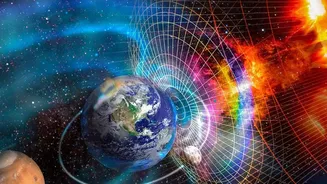
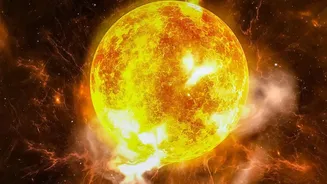
Understanding the fundamental physics of our sun is not just an academic exercise. The same magnetic energy that heats the corona also fuels solar flares and coronal mass ejections (CMEs) — massive eruptions of plasma that hurtle through space. These events create what is known as "space weather," which can have significant impacts here on Earth. A powerful solar storm could disrupt satellite communications, damage power grids, and pose a risk to astronauts. By better understanding the basic mechanisms of how energy builds up and moves through the sun's atmosphere, scientists can improve their models and forecasts for space weather. This recent discovery of plasma vortices provides a crucial new detail in that complex picture, ultimately enhancing our ability to predict and prepare for the sun's more violent outbursts.