

A Glimpse of Our Sun's Future
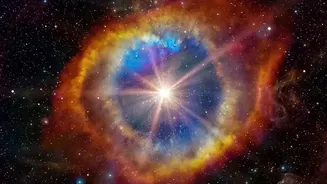
The Helix Nebula is what astronomers call a planetary nebula, a name that's a bit of a historical misnomer. Early astronomers with less powerful telescopes thought these glowing, spherical clouds resembled planets. In reality, they have nothing to do
with planets; they are the elaborate, glowing remnants of a star much like our own Sun. When a Sun-like star runs out of its primary nuclear fuel, it can no longer support itself against its own gravity. Its core collapses while its outer layers puff away into space. The Helix Nebula is a snapshot of this process, offering a preview of the fate that awaits our solar system in about five billion years. It is one of the closest and brightest examples of a star's final, glorious act.
The Dying Star at the Center
At the heart of the nebula, though often outshone by the brilliant gas it illuminates, is the culprit behind the whole spectacle: a tiny, incredibly hot star known as a white dwarf. This is the collapsed core of the original star. Having cast off its outer atmosphere, this stellar remnant is now extraordinarily dense and blazingly hot, with a surface temperature of around 120,000 degrees Celsius. It is the intense ultraviolet radiation pouring from this white dwarf that causes the previously ejected gas shells to light up, or fluoresce, creating the vibrant colors and intricate shapes we see. This central star is now in its retirement phase, destined to cool and fade over billions of years.
Sculpted by Powerful Stellar Winds
The nebula's complex structure isn't just a simple, expanding bubble. It's a dynamic environment shaped by powerful forces. The process began when the aging star, in its red giant phase, shed its outer layers as a relatively slow-moving wind. Later, as the core became exposed, it unleashed a new, much faster stellar wind. The stunning patterns we see are the result of this high-speed wind crashing into the slower material that was ejected earlier. This cosmic collision creates shockwaves and intricate filaments, sculpting the gas and dust into the rings and shells that give the nebula its eye-like appearance. Recent studies suggest the shapes of planetary nebulae are influenced long before they form, with companion planets or other stars potentially stirring up stellar winds into complex patterns.
The Mystery of the Cometary Knots
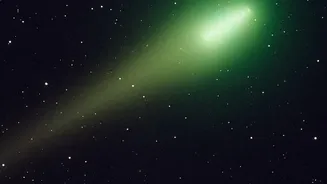
One of the most intriguing features of the Helix Nebula is the presence of thousands of small, dense globules of gas that look like comets, complete with bright heads and long, streaming tails. These "cometary knots" are enormous, despite their delicate appearance. The heads of these knots are often larger than our entire solar system, and their tails can stretch for a hundred billion miles. They are not actual comets, but dense pockets of molecular gas that have managed to survive the otherwise harsh radiation from the central star. The glowing heads are the surfaces being ionized by the star's light, while the tails are the shadows behind them, shielding the gas from the intense radiation. Astronomers are still studying exactly how these knots form, but they represent a fascinating piece of the puzzle in understanding how stellar material is recycled back into the galaxy.