




Earth: Our Only Blueprint for Life
To find life elsewhere, we first need to understand what it looks like. Earth is our only working example of a planet with a biosphere, making its 4.5-billion-year history a unique instruction manual. Astrobiologists and geologists work as planetary detectives,
studying ancient rocks to reconstruct the story of how life began and evolved here. This is crucial because for most of its history, life on Earth was purely microbial and existed in environments that would be totally alien to us today, with an oxygen-free atmosphere and a fainter sun. By studying these 'alien' periods in our own planet's past, scientists can build a reference guide for what life might look like on a completely different world.
Decoding the Fingerprints of Life
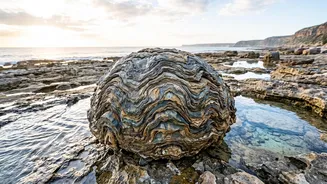
Life leaves behind clues in the geological record called 'biosignatures'. These aren’t just fossils of bones or shells. For ancient microbial life, they are much more subtle. Geologists hunt for chemical fingerprints, such as specific ratios of carbon isotopes. Living organisms tend to prefer the lighter carbon-12, so rocks containing organic matter derived from life will have a different carbon signature than rocks formed by purely geological processes. Another key biosignature can be found in layered rock structures called stromatolites, which are formed by microbial mats over long periods. By learning to identify these faint traces in rocks that are billions of years old and have been altered by heat and pressure, scientists can refine their toolkit for analysing rock samples from other planets, like Mars.
From Ancient Rocks to Exoplanet Atmospheres
Studying Earth's geology doesn't just help us know what to look for on the surface of other planets; it helps us interpret data from their atmospheres. Telescopes can analyse the starlight that passes through an exoplanet's atmosphere, revealing which chemical gases are present. But what do those gases mean? Earth’s geological history shows a complex interplay between life and the atmosphere. For example, before the 'Great Oxidation Event' around 2.4 billion years ago, Earth's atmosphere was likely rich in methane produced by early microbes. An oxygen-rich atmosphere came much later. By understanding how Earth's atmosphere evolved due to both biological and geological activity (like volcanism and plate tectonics), scientists can create more accurate models to determine if the presence of gases like oxygen, methane, or nitrous oxide on another world is a tantalizing hint of life or just a result of non-biological chemistry.
Earth's Extremes as Alien Analogs
Long before complex life, Earth's microbes thrived in extreme conditions that mirror environments we see elsewhere in the solar system. Planetary geologists study these 'analogs' to understand the limits of life. The Atacama Desert serves as a model for the dry, harsh surface of Mars. The cold, dark waters beneath Antarctic ice are an analog for the subsurface oceans suspected to exist on moons like Europa and Enceladus. Even deep-sea hydrothermal vents, which host ecosystems that thrive on chemical energy instead of sunlight, provide a template for what life could look like on the seafloor of an alien ocean world. By studying the geology and biology of these extreme locations, we learn where to point our rovers and probes and what kinds of hidden ecosystems we might find.
Avoiding the Ultimate False Positive
One of the greatest challenges in the search for extraterrestrial life is distinguishing a true biosignature from an abiotic mimic. Certain geological or chemical processes can create structures or leave behind chemical traces that look a lot like signs of life. Iron-mineral filaments found in ancient rocks, for instance, have been debated as either some of Earth's oldest fossils or simply the result of non-biological mineral formation. This is where a deep understanding of geoscience becomes indispensable. By documenting all the ways that geology can create 'impostor' biosignatures, scientists can build a rigorous framework for evaluation. It raises the standard of proof, ensuring that when—and if—we finally claim to have found evidence of alien life, we have ruled out every other possibility.