


A New Frontier of Planets
In the cosmic zoo of planets, some of the most common are worlds completely alien to our own solar system: super-Earths. These are planets with a mass higher than Earth's but less than that of Neptune. They can be rocky like Earth or more like mini gas
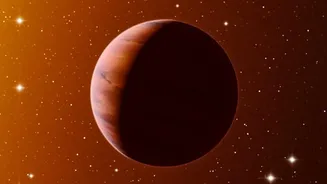
giants. For decades, scientists could only guess at their nature, but finding one with an atmosphere, let alone one containing water, has been a primary goal in astronomy. This is because super-Earths represent a crucial class of planet—abundant in the galaxy and potentially capable of holding onto conditions suitable for life. The recent discovery focuses on a planet orbiting its star at a scorching temperature, making it inhospitable. However, the presence of water vapour is a watershed moment, not because this specific planet is habitable, but because it proves we can now find the ingredients for habitability elsewhere.
How Webb Reads the Stars
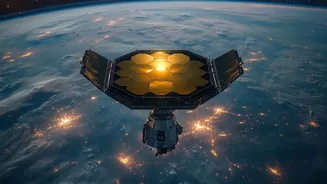
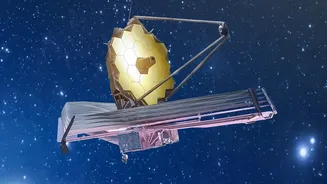
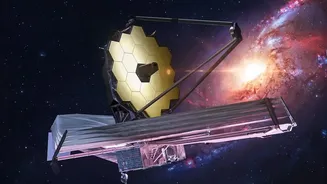
So how did the JWST peer into the atmosphere of a world light-years away? The answer lies in its powerful ability to see the universe in infrared light, a spectrum invisible to the human eye. The technique is called transmission spectroscopy. As the exoplanet passes in front of its host star, a tiny fraction of the starlight filters through the planet's atmosphere. Different molecules in that atmosphere absorb specific wavelengths, or colours, of light. This creates a unique chemical barcode in the spectrum that the telescope receives. By analyzing which parts of the light spectrum are missing, astronomers can determine with incredible precision what molecules are present. In this case, the data revealed a clear absorption pattern corresponding to water vapour (H2O), a molecule vital for life as we know it.
A Technological Triumph
Detecting an atmosphere around a massive gas giant is one thing, but doing so for a smaller, rocky world is exponentially more difficult. The atmospheric layer is much thinner, and the signal is therefore fainter. This detection is being hailed as a 'breakthrough' because it confirms the JWST is sensitive enough to perform this delicate task. It represents the successful culmination of decades of engineering and a massive investment by international space agencies. Previously, hints of water have been found on other worlds, but often with ambiguity. Sometimes the water signature could be coming from the star itself, not the planet. What makes this recent finding so robust is the quality of the data and the sophisticated models used to confirm that the water is indeed part of the planet's atmospheric system. This proves the method works, opening the door for dozens of other rocky worlds to be similarly scrutinized.
The Search for Another Earth
It is crucial to be clear: scientists have not found a habitable planet. The super-Earth in question is far too hot for liquid water to exist on its surface. Instead, what they have found is arguably more important in the long run. They have proven they possess the right tool to one day find a truly habitable world. This discovery is a critical stepping stone. Having confirmed water vapour on a hot, rocky world, the next logical step is to point the JWST at cooler super-Earths that orbit within their star's 'habitable zone'—the region where temperatures could allow for liquid surface water. The detection of water vapour in a planet's atmosphere is a key indicator that a planet might be able to support such an ocean. This result sharpens the focus in the ongoing search, moving it from a game of probabilities to one of direct chemical analysis.