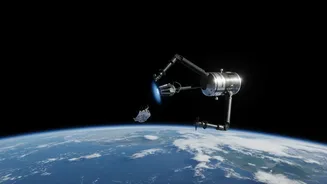








The Growing Peril in Our Skies
Low Earth Orbit (LEO), the orbital highway just above our atmosphere, is essential for everything from GPS navigation and internet services to climate monitoring. However, this vital region is increasingly cluttered. Decades of space activity have left
behind thousands of defunct satellites, spent rocket stages, and fragments from past collisions. There are over 8,000 pieces of catalogued debris, alongside countless smaller, untracked objects. Travelling at speeds exceeding 28,000 kilometres per hour, even a small piece of junk can strike an active satellite with catastrophic force, potentially triggering a chain reaction of more debris creation. This poses a significant threat to current and future space operations, including valuable commercial satellite constellations.
The Challenge of a Tumbling Target
Removing this debris is not as simple as just grabbing it. Many of these dead satellites are not stable; they are tumbling uncontrollably. Attempting to capture a fast-spinning, multi-tonne object with a robotic arm, net, or harpoon is incredibly risky. A miscalculation could lead to a disastrous collision, damaging the capture spacecraft and creating even more debris. The unpredictable motion makes it extremely difficult to securely latch on without endangering the mission. This is why a contactless method—one that can stabilize the target before capture—is so desirable in the field of active debris removal.
Enter the Magnetic Tether Solution
This is where magnetic tethers, specifically those using eddy currents, come into play. Instead of a physical grab, this method uses fundamental principles of electromagnetism to influence the target from a safe distance. A 'chaser' spacecraft, equipped with powerful electromagnets, approaches the tumbling piece of debris. The key is that it doesn't need to make contact to begin its work. Most satellite bodies are made of conductive, non-magnetic materials like aluminium alloys. By projecting a strong, changing magnetic field at the target, the chaser can begin to interact with and control it without ever touching it.
How Eddy Currents Work Their Magic
The process relies on something called an eddy current brake. As the chaser spacecraft holds its electromagnet near the spinning, conductive satellite, the moving magnetic field induces small, circular electrical currents—eddy currents—within the debris's metallic structure. According to the laws of physics, these newly created eddy currents generate their own magnetic field that opposes the one from the chaser spacecraft. This opposition creates a gentle, contactless braking force, or torque. Over time, this magnetic drag slows the satellite's spin until it is stable enough for a safe capture. Think of it as a ghostly brake that requires no physical contact, significantly reducing the risk of a capture mission going wrong.
From a Gentle Grip to Fiery Disposal
Once the tumbling has been neutralized, the chaser spacecraft can move in for the final phase. In some concepts, the magnetic force itself is strong enough to act as a 'tether', allowing the chaser to tow the debris. Other designs use the magnetic braking to stabilize the target before a more conventional robotic arm performs the final grab on a now-stationary object. After securing the junk satellite, the chaser spacecraft fires its thrusters to move the combined stack into a lower orbit. This trajectory ensures that the debris is dragged into Earth's atmosphere, where it will safely and completely burn up on reentry, posing no further threat.
Pioneering Orbital Sustainability
This is not just a theoretical concept. The European Space Agency (ESA) has explored magnetic capture as part of its Clean Space initiative, studying missions to remove large pieces of debris. Private companies are also at the forefront. Japan's Astroscale, for instance, has successfully demonstrated a magnetic docking plate system in orbit with its ELSA-d mission, proving that the technology for magnetic capture is viable. While some of these systems are designed for future satellites equipped with a docking plate, the eddy current method holds promise for clearing older debris that was never designed to be captured.