




A Sweet Discovery in a Cosmic Cloud
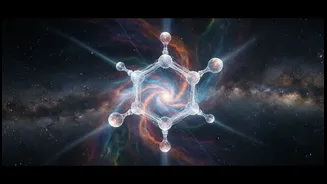
Scientists have announced the first-ever detection of a complex sugar molecule, known as erythrulose, in interstellar space. The discovery was made within a vast, dense cloud of gas and dust called G+0.693-0.027, located roughly 27,000 light-years from
Earth, near the supermassive black hole at the center of the Milky Way. On Earth, erythrulose is a four-carbon sugar found naturally in fruits like raspberries. Finding it floating in the cold, dark expanse between stars is a landmark achievement that strengthens the theory that the essential chemical precursors for life are not unique to our planet but are widespread throughout the galaxy.
The Galactic Chemical Factory
The region near the galactic center is a chaotic and energetic environment. Giant molecular clouds, like the famous Sagittarius B2 and the newly highlighted G+0.693-0.027, act as colossal chemical factories. These clouds are incredibly dense and cold, with temperatures hovering just above absolute zero. Within these frigid depths, tiny dust grains become coated in ice. These icy surfaces provide the perfect platform for simple atoms and molecules to meet, react, and combine into larger, more complex structures—a process astrochemists believe is crucial for forming prebiotic molecules. For decades, scientists have pointed radio telescopes at these clouds, detecting over 340 different molecules, but a complex sugar had remained elusive until now.
How They Found the Molecular Ghost
Detecting a specific molecule across thousands of light-years is a feat of cosmic detective work. Researchers used powerful radio telescopes in Spain to listen for specific frequencies of light emitted by the molecular cloud. Every molecule rotates and vibrates, emitting or absorbing energy at a unique set of frequencies, creating a distinct 'fingerprint'. The team, led by astrochemists at Spain's Center for Astrobiology, compared the faint signals from the G+0.693-0.027 cloud with the known laboratory signature of erythrulose. After carefully filtering out all the other cosmic noise, they found a clear match. The discovery was somewhat surprising, as the team had initially been searching for simpler three-carbon sugars and found none, suggesting our models for how these molecules form in space may need revising.
A Building Block for Life?
While erythrulose itself isn't a direct component of DNA, its discovery is profoundly significant. Sugars are fundamental to all known life, forming the backbone of RNA and playing a key role in cellular metabolism. Previously, sugars like ribose had been found in meteorites that have fallen to Earth, suggesting they could be delivered from space. This new detection proves that such complex sugars can form in the interstellar medium before stars and planets even exist. It supports the idea that nascent planets, including the early Earth, could have been seeded with these essential building blocks, providing a head start for the development of life. As one researcher noted, this finding opens the door to searching for even more significant molecules, like ribose, in these stellar nurseries.