





The Anatomy of Phone Slouch
When you tilt your head forward to scroll through your phone, the weight on your cervical spine increases dramatically. This forward head posture causes the muscles in your upper back to overstretch and weaken, while the muscles in your chest tighten.
This imbalance is what leads to the characteristic rounded shoulders. Meanwhile, your lower back often compensates for this forward lean, leading to strain and chronic discomfort. The good news is that a consistent yoga practice can actively counteract these patterns by strengthening weak muscles, stretching tight ones, and restoring your body's natural alignment.
1. Marjaryasana-Bitilasana (Cat-Cow Pose)
This gentle, flowing movement is one of the best ways to warm up the spine and release tension. The Cow Pose (Bitilasana) stretches the front of your torso and chest, directly countering the hunched-forward position, while the Cat Pose (Marjaryasana) gently rounds the spine to relieve stiffness. This dynamic duo improves spinal flexibility, boosts circulation to the back muscles, and enhances body awareness, making it a foundational movement for better posture.\nHow to do it: Start on your hands and knees in a tabletop position, with wrists under shoulders and knees under hips. As you inhale (Cow), drop your belly, lift your chest and tailbone, and look forward. As you exhale (Cat), press into your hands, round your spine toward the ceiling, and tuck your chin to your chest. Flow between these two poses for 5-10 breaths.
2. Bhujangasana (Cobra Pose)
Cobra Pose is a powerful backbend that specifically targets the issues caused by slouching. It strengthens the entire back, opens the shoulders, and stretches the chest. By lifting your chest off the floor using your back muscles, you activate the spinal extensors that have become weak from constant hunching. Regular practice helps correct rounded shoulders and can alleviate lower back stiffness by promoting spinal flexibility.\nHow to do it: Lie on your stomach with your legs extended and palms flat on the floor under your shoulders, elbows tucked in. Press the tops of your feet and thighs into the mat. On an inhale, use your back strength to gently lift your head and chest off the floor. Roll your shoulders back and down, keeping your neck long. Hold for a few breaths before releasing.
3. Gomukhasana (Cow Face Pose Arms)
While the full pose involves the legs, practising just the arm variation is incredibly effective for opening tight shoulders and the chest, two primary victims of phone use. This deep stretch targets the triceps, shoulders, and latissimus dorsi (the large muscles on the sides of your back). It directly counteracts the internal rotation of the shoulders that defines a slouching posture, helping to improve mobility and relieve upper body tension.\nHow to do it: Sitting or standing tall, reach your right arm up, bend the elbow, and let your right hand drop down your back. Reach your left arm behind your back, palm facing out, and walk your left fingers up to clasp your right fingers. If they don't reach, hold a strap or towel between them. Keep your spine straight and chest lifted. Hold for 30 seconds, then switch sides.
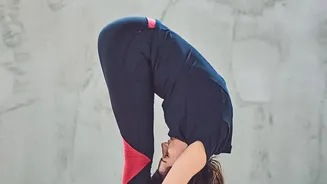
4. Uttanasana (Standing Forward Bend)
This pose may seem simple, but it offers profound relief for both the spine and hamstrings. Tight hamstrings can pull on the pelvis and contribute to lower back pain, a common issue for those who sit for long periods. Uttanasana provides a deep stretch for the entire back of the body, from your heels to your neck, helping to decompress the spine and release tension. Bending your knees generously allows your lower back to release more effectively.\nHow to do it: Stand with feet hip-width apart. Hinge at your hips, not your waist, and fold forward, keeping your spine as long as possible. Bend your knees enough to allow your torso to rest on your thighs. Let your head and neck hang heavy. You can rest your hands on the floor, on blocks, or grasp opposite elbows. Hold for 5-10 deep breaths.