







Our Star's Hidden Glow
To us on Earth, the Sun appears as a dependably steady source of light and warmth. We chart our days by its rise and fall, and its energy powers life itself. But for solar physicists, the Sun is a place of violent and complex activity. A recent breakthrough
by India's Aditya-L1 solar mission has added a new layer to this complexity, confirming the presence of a ghostly phenomenon known as iron fluorescence during powerful solar flares. This isn't just a minor detail; it’s a new way of seeing the Sun’s turbulent atmosphere, providing a tool that was theorised for 50 years but has only now been comprehensively observed. This discovery forces us to update our picture of the Sun, transforming it from a simple ball of fire into something far more intricate and mysterious.
What Exactly Is Iron Fluorescence?
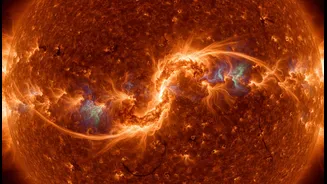
Imagine a blacklight poster. It absorbs invisible ultraviolet light and re-emits it as a vibrant, visible glow. Iron fluorescence on the Sun works on a similar principle, but at a much more extreme energy level. The process begins during a solar flare, an enormous explosion in the Sun’s upper atmosphere, or corona. These flares heat the corona to millions of degrees, generating a massive burst of high-energy X-rays. While most of this radiation shoots out into space, some is directed back down towards the Sun’s cooler visible surface, the photosphere. There, it strikes the abundant iron atoms, energising them. The iron atoms absorb these high-energy X-rays and, in response, re-emit their own characteristic X-ray glow at a lower, specific energy, a process called fluorescence. This fluorescent glow is a direct echo of the flare happening far above it in the corona.
A New Tool for Solar Detectives
The detection of this iron fluorescence is a major achievement for India's Aditya-L1 space observatory and its SoLEXS instrument (Solar Low Energy X-ray Spectrometer). What makes this discovery so significant is not just that it happens, but how it can be used. Scientists found that the strength of the iron glow depends on where the solar flare occurs on the Sun. Flares near the center of the Sun's disk produce a strong fluorescence signal. However, flares happening near the Sun's edge, or limb, show a much weaker signal because the glow has to travel through more of the dense solar atmosphere to reach us. This difference allows scientists to use the fluorescence as a diagnostic tool. By measuring its strength, they can pinpoint the altitude of the X-ray source in the corona, helping them build a 3D picture of how and where these explosive events unfold.
Iron's Puzzling Role
Iron has long been a source of intrigue for solar physicists. Despite making up less than 0.2% of the Sun's mass, it plays an outsized role in how the star operates. Its ability to absorb and block the flow of energy, known as its opacity, is crucial for models of the Sun’s interior. For years, scientific models of the Sun have struggled to reconcile theory with observations, and iron's behaviour was a prime suspect. Some experiments have suggested iron's opacity is much higher than predicted, which would help solve long-standing discrepancies in our understanding of how energy moves from the core to the surface. This new ability to observe iron fluorescence adds another piece to the puzzle, giving scientists a direct way to probe the interaction between the Sun’s hot, chaotic corona and its cooler surface, all through the language of iron.