


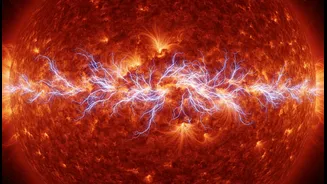


What is the Tachocline?
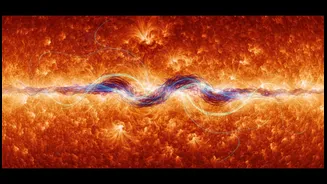
Imagine a boundary deep within the Sun where two distinct regions meet and clash. Above it, the convection zone boils and churns like a thick soup, with its outer parts at the equator spinning faster than its poles. Below it, the radiative zone rotates
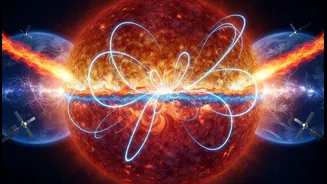
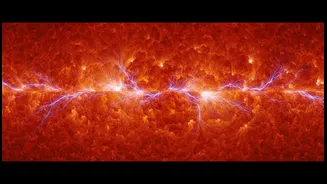
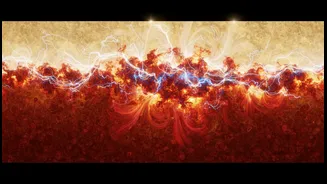
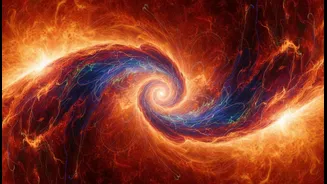
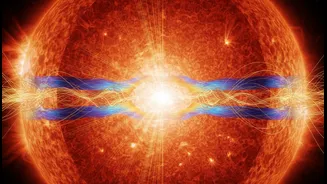
as a solid, unified ball. The tachocline is the incredibly thin, turbulent interface where these two zones shear against each other. First theorised in 1992, this layer is only about 4% of the Sun's radius thick, yet the intense mechanical stress within it is believed to be the engine of the Sun's immense magnetic power. It is a place of immense physical conflict, where the Sun's rotation profile changes dramatically, setting the stage for powerful cosmic events.
The Engine of Solar Magnetism
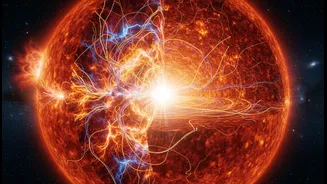
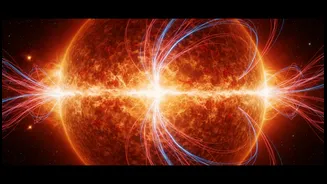
The tachocline is widely considered the birthplace of the solar dynamo—the process that generates the Sun's massive magnetic field. The shearing motion, where the fast-differentiated rotation of the convection zone rubs against the steady radiative zone, effectively stretches, twists, and amplifies magnetic field lines. Think of it like twisting a rubber band until it stores a huge amount of energy. This process, known as the omega effect, creates powerful, rope-like magnetic structures that become coiled and unstable over time. Recent studies using helioseismology—the study of the Sun's interior through its vibrations—provide strong evidence that the dynamo originates deep within the Sun, right near the tachocline, rather than closer to the surface.
From Magnetism to Eruptions
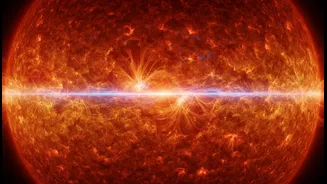
When the magnetic energy built up in the tachocline becomes too great, it must be released. Buoyant magnetic field loops rise through the convection zone to the surface, creating sunspots. When these tangled magnetic field lines on the Sun's surface snap and realign, they unleash tremendous bursts of energy known as solar flares and coronal mass ejections (CMEs). A solar flare is an intense flash of radiation, while a CME is a gigantic cloud of magnetised plasma hurled into space at millions of kilometres per hour. These are not small events; a single powerful CME can contain billions of tons of solar material. It is the tachocline's function as a magnetic dynamo that ultimately fuels these spectacular and potentially dangerous eruptions.
A Threat to Our Digital World
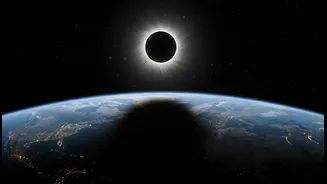
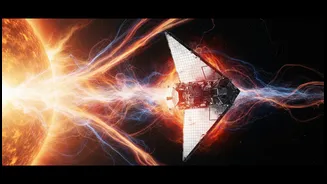
While beautiful to observe from afar, a CME directed at Earth poses a significant threat to our technologically dependent society. When these charged particles and magnetic fields slam into our planet's magnetosphere, they can trigger severe geomagnetic storms. These storms can induce powerful electrical currents in long conductors on the ground, potentially overloading and destroying transformers in national power grids, leading to widespread and long-lasting blackouts. In space, the danger is even more immediate. The intense radiation can damage or disable critical satellites responsible for GPS navigation, financial transactions, and communications—including mobile networks and television broadcasting. For a nation like India, with its growing satellite fleet and digital infrastructure, the risk is substantial.
Forecasting the Sun's Fury
Understanding the tachocline is therefore not just an academic pursuit; it is crucial for space weather forecasting. By modelling the behaviour of the tachocline and the solar dynamo, scientists hope to better predict when and how large solar eruptions might occur. This advanced warning is critical for protecting our infrastructure. Satellite operators can put their spacecraft into a safe mode, and power grid managers can take steps to mitigate the impact of geomagnetic currents. India's own Aditya-L1 mission, now in orbit, is a key part of this global effort. By studying the Sun's atmosphere, eruptions, and the solar wind, Aditya-L1 will provide vital data to improve our forecasting models and help discover the mysteries of the Sun-Earth connection.