






A New Space Race, Driven by Startups
For decades, the Indian space story was synonymous with the Indian Space Research Organisation (ISRO). But a major transformation is underway. Since the government opened the sector to private participation in 2020, India has witnessed a boom in space-tech
startups, growing from a handful to over 400 by 2026. This shift is driven by a clear vision: to expand India's share of the global space economy from its current 2-3% to a more ambitious 8% by 2033, with projections estimating the domestic industry's value could soar to US$44 billion. Facilitating this is the Indian National Space Promotion and Authorisation Centre (IN-SPACe), a single-window agency designed to help private firms navigate regulations and access ISRO's world-class infrastructure. This has unleashed a new wave of commercial energy, with companies now designing everything from launch vehicles to satellite constellations.
The Pivot from Rockets to Revenue Streams
Historically, the focus of any space program was 'upstream' activity: building and launching rockets and satellites. While that remains crucial, the real explosive growth is happening in the 'downstream' sector. This involves using the vast amounts of data beamed back to Earth from satellites for commercial applications. Think about it: satellite imagery and data are revolutionising industries. In agriculture, it helps monitor crop health and soil moisture for precision farming. In logistics, it optimises global supply chains. In finance, it can be used to track economic activity. It also plays a vital role in telecommunications, urban planning, disaster management, and climate change monitoring. This data is the new oil, and an entire industry is rising to refine and use it. This is where software and data professionals come in.
The Data Deluge from Orbit
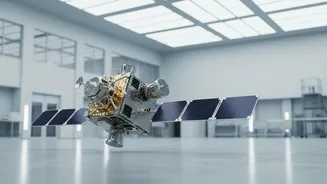
Every satellite is a high-tech sensor, generating terabytes of data daily. Making sense of this information requires a specialised skill set. The industry needs data scientists and analysts who can build algorithms to process raw satellite imagery, identify patterns, and generate actionable insights. For instance, an insurance company might use satellite data to assess damage after a flood, or a city planner might use it to monitor urban sprawl. This requires expertise in big data analytics, machine learning (ML), and artificial intelligence (AI). As private Indian companies like Pixxel build constellations of earth-observation satellites, the demand for professionals who can turn petabytes of data into profitable business solutions will only escalate.
Software Is the Brains of the Operation
Modern spacecraft are increasingly 'software-defined'. Their capabilities are no longer just determined by their physical hardware but by the sophisticated software that controls them. This requires a wide range of software expertise. Flight software engineers are needed to write the code that manages a satellite's orientation, propulsion, and communications. With growing satellite constellations, there's a need for developers who can create autonomous systems for orbit management and collision avoidance. Cybersecurity is another critical area; as space assets become more integral to our economy and security, protecting them from digital threats is paramount. Furthermore, the rise of edge computing in space—processing data on the satellite itself to reduce latency and bandwidth use—creates new demand for engineers who can build efficient, radiation-tolerant software systems.
Bridging the Emerging Talent Gap
This rapid pivot towards a software-and-data-centric space industry is creating a talent crunch. While India has a vast pool of IT professionals, the space sector requires a unique, multidisciplinary skill set combining domain knowledge with advanced tech capabilities. Experts estimate that the Indian space industry could need around 40,000 technically skilled professionals over the next five years. However, university curricula have been slow to adapt, often lacking hands-on experience in areas like flight software development or AI-driven satellite data analysis. To address this, organisations like IN-SPACe are partnering with academic institutions to develop specialised courses. Private companies are also investing heavily in their own training programs to upskill engineers from other fields, recognising that talent is now as critical as technology for success.