




Earth's 'Evil Twin' Planet
Often called Earth's twin due to its similar size and mass, Venus is anything but hospitable. Its atmosphere is a cautionary tale, composed of 96% carbon dioxide, which creates an intense greenhouse effect. This has triggered a "runaway" scenario, where
heat is trapped so effectively that surface temperatures soar to around 465°C, hot enough to melt lead. Any early oceans on Venus boiled away long ago, turning into water vapour that further amplified the heating before escaping into space. The result is a crushing atmospheric pressure over 90 times that of Earth's and a planet shrouded in toxic sulphuric acid clouds. Scientists believe Venus represents an extreme endpoint of climate change, a planetary-scale lesson in what happens when the greenhouse effect spirals out of control.
India’s Intensifying Climate Challenge
Back on Earth, India is on the front lines of a very different, yet unnervingly related, climate struggle. The nation is experiencing a sharp increase in extreme weather events, from blistering heatwaves to erratic and intense monsoon rains that cause devastating floods. Major cities like Delhi and Mumbai are projected to see a doubling of heatwave days, while extreme rainfall events are expected to rise significantly across the country. These changes pose a direct threat to India's agriculture, water security, public health, and economic stability. The delicate balance that governs the monsoon, crucial for the livelihoods of millions, is becoming increasingly unpredictable, making accurate climate modelling more critical than ever.
Shukrayaan: India's Voyage to Venus
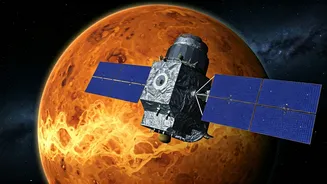
This is where the study of Venus becomes directly relevant. The Indian Space Research Organisation (ISRO) is planning its first-ever mission to Venus, called Shukrayaan. Scheduled for launch in the coming years, the orbiter is designed to conduct a comprehensive study of the Venusian atmosphere, surface, and its interaction with the sun. One of the key scientific objectives is to better understand the atmospheric dynamics of Venus, including its thick clouds and extreme greenhouse effect. By sending its own probe, India joins a global effort to unravel the mysteries of how its celestial twin evolved so differently, gathering data that has profound implications for our home planet.
A Laboratory for Climate Models
The core connection lies in data. Climate models used to predict future scenarios on Earth are complex, but they are based on the fundamental laws of physics. Venus provides the ultimate stress test for these models. If scientists can accurately simulate the extreme climate of Venus, it dramatically increases their confidence in the models used to forecast climate change on Earth. By understanding the atmospheric tipping points that led to Venus’s runaway greenhouse state, researchers can refine their predictions for India's own climate trajectory. For instance, studying the behaviour of Venus's sulphuric acid clouds helps improve our understanding of cloud physics in general, which is a crucial variable in predicting the intensity and timing of India's monsoons.
Beyond a Simple Warning
While Venus serves as a stark warning, it is not our direct destiny. The runaway greenhouse effect on Venus was likely triggered by natural processes over millions of years, possibly massive volcanic eruptions. Earth is not on the verge of becoming Venus. However, the lessons are invaluable. Studying a planet where the climate system has been pushed to its absolute limit provides insights into atmospheric dynamics that are impossible to replicate in a lab. This knowledge helps scientists identify key vulnerabilities and feedback loops in our own climate system. The data gathered by missions like Shukrayaan will help us understand not just how a planet can die, but how we can better protect the one we live on.