



The Prohibitive Cost of a Cosmic Grocery Run
Imagine packing for a three-year trip where you can't stop for supplies. That's the reality for a mission to Mars. Water is heavy, and launching anything into space is astronomically expensive; every kilogram costs thousands of dollars. A crewed Mars mission could
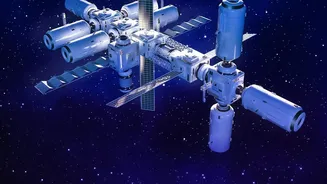
last up to three years, and the sheer volume of water and oxygen needed would make the spacecraft impossibly large and heavy to launch. Relying on resupply missions, as the International Space Station (ISS) partially does, is not an option when you're millions of kilometers from Earth. This economic and logistical reality makes one thing clear: for long-duration deep-space habitats to be viable, they must be almost entirely self-sufficient. Astronauts can't survive without a closed-loop system that can regenerate essential resources.
Yesterday's Coffee is Today's Coffee
On the International Space Station, there's a running joke that yesterday's coffee becomes today's coffee. While it sounds unappetizing, it's a testament to the incredible efficiency of the station's Environmental Control and Life Support System (ECLSS). This system reclaims every possible drop of water from sources you might not expect: the crew's breath, their sweat, and even their urine. The Water Recovery System uses a multi-step process to achieve this. Moisture from the cabin air is collected through condensation. Separately, a Urine Processor Assembly uses a low-pressure vacuum to distill and evaporate water from urine. These collected waters are then combined and passed through a series of sophisticated filters and a high-temperature catalytic reactor that purifies them, producing water that is often cleaner than what many people drink on Earth. Current systems on the ISS can recover over 90% of the water on board, dramatically reducing the need for resupply.
Creating Breathable Air in the Void
Just as critical as water is the air astronauts breathe. The ECLSS is also a master of atmospheric management. First, it must remove the carbon dioxide (CO2) that astronauts exhale. Systems scrub the CO2 from the cabin air, preventing a toxic buildup. But the real genius is in what happens next. Instead of just venting the CO2, advanced systems use it. The Oxygen Generating System uses electrolysis to split water molecules (H2O) into hydrogen and breathable oxygen, which is then released into the cabin. The leftover hydrogen can be combined with the captured CO2 in a device called a Sabatier reactor. This process creates more water—which can be recycled again—and methane, which is typically vented into space. This elegant loop closes the circle, turning a waste product into a vital resource.
The Challenge of 100% Self-Sufficiency
While the technology on the ISS is revolutionary, it's not yet perfect for a Mars mission. The current systems are not 100% efficient and require frequent maintenance and replacement parts that are sent on resupply rockets. For a three-year journey to Mars, systems must be more robust, more reliable, and even more efficient, pushing for nearly 100% closure of the air and water loops. Engineers are developing next-generation systems for NASA's Artemis program and future Mars missions. These include technologies to extract every last bit of water from brine (the salty byproduct of urine processing) and more advanced CO2 conversion methods. Furthermore, these systems must be highly autonomous, capable of self-diagnosis and even robotic repair, as the crew will be too far away for Mission Control to walk them through complex fixes.
The True Engine of Exploration
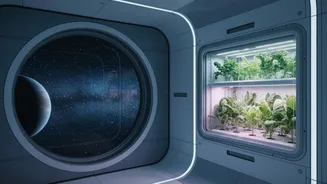
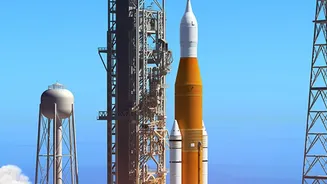
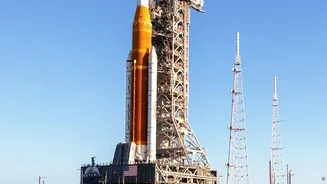
Powerful rockets and sleek spacecraft often get the glory, but it's the unglamorous, humming machinery of the life support systems that are the true enablers of deep-space exploration. These technologies are what transform a simple vehicle into a long-term habitat where humans can live and work. As we look towards building permanent bases on the Moon and sending the first explorers to Mars, the continued evolution of these regenerative systems will be critical. They represent the crucial link between human biology and the harsh reality of space, creating a tiny, life-sustaining bubble modeled after our own planet as we venture further into the cosmos than ever before.