





A Landmark Collaboration
Technopark-based space-tech startup HEX20 has become the first Indian private company selected to contribute to a deep-space mission for the United Arab Emirates. The company is providing critical engineering for a probe destined for the 'Emirates Mission
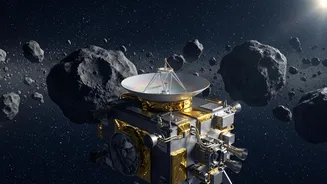
to the Asteroid Belt' (EMA), an audacious project set to explore seven different asteroids. The partnership was officially unveiled in the presence of Sheikh Hamdan bin Mohammed bin Rashid Al Maktoum, Crown Prince of Dubai, highlighting its national importance for the UAE. HEX20 was chosen by the UAE Space Agency and the Technology Innovation Institute (TII) back in November 2024, and has since been developing key components for the mission.
The Indian-Made Technology Aboard
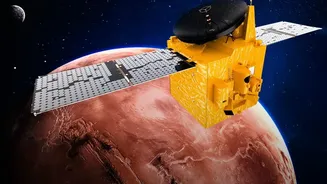
HEX20's primary contribution is the development of the spacecraft bus for the probe, which is the foundational framework that houses and supports the probe's scientific instruments and operational systems. The startup is also responsible for the mission's complex software. A significant portion of the work, including the development of the onboard computer and robust power systems designed to endure the harsh environment of deep space, was carried out by the company's engineering team in Thiruvananthapuram and Abu Dhabi. This hardware, developed in Kerala, is set to travel farther into the cosmos than any privately built Indian technology before it. According to the company's CEO, Amal Chandran, the project demonstrates HEX20's capability to deliver high-quality spacecraft systems for incredibly demanding missions.
Inside the MBR Explorer Mission
The probe built with HEX20's technology will be part of the larger MBR Explorer spacecraft, named after the UAE's Prime Minister Sheikh Mohammed bin Rashid Al Maktoum. Scheduled for launch in March 2028 from Japan, the mission is a monumental undertaking. The MBR Explorer will travel approximately five billion kilometres on an eight-year journey, using gravity assists from Venus, Earth, and Mars to navigate its way to the main asteroid belt located between Mars and Jupiter. It will perform fly-bys of six asteroids before its final rendezvous with its primary target: the asteroid 269 Justitia, which it is expected to reach in 2034.
A 'Hard Landing' on a Mysterious World
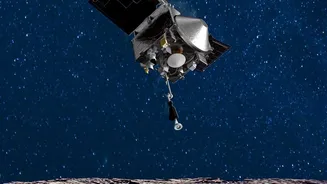
The mission's climax will involve the probe detaching from the MBR Explorer and descending to the surface of 269 Justitia. This final phase is described as a 'hard landing' or a controlled impact, as the probe will capture and transmit data continuously during its descent. The asteroid Justitia is of particular scientific interest due to its unusual reddish colour, which suggests it may hold clues about the origins of our solar system, including the distribution of water and organic materials. The insights gained from this close-up study could be invaluable to understanding how planets are formed.
A Giant Leap for India's Private Space Sector
This collaboration is a powerful testament to the rapid growth and increasing sophistication of India’s private space industry. Since the sector was opened to private participation in 2020, the number of space startups has surged from just one in 2014 to over 400. The government's goal is to expand India's share of the global space economy from its current value of around $8 billion to over $40 billion by 2030. Companies like HEX20, Skyroot Aerospace, and Pixxel are not just serving domestic needs but are actively securing international contracts and partnerships, showcasing India's competitive edge in building reliable and cost-effective space technology. This mission places an Indian startup at the heart of a landmark international scientific endeavor, signaling a new era of global collaboration for the country's space ecosystem.