




For decades, we’ve understood the universe to be about 13.8 billion years old. But what if it’s actually twice that age? A new model from a Canadian physicist suggests just that, potentially solving some of cosmology's biggest puzzles.
Our Standard Cosmic Story
The prevailing theory
of cosmic history is known as the Lambda-CDM model. It’s the framework that tells us the universe began with the Big Bang approximately 13.8 billion years ago. This age isn't a guess; it's calculated from multiple, interlocking lines of evidence, including the expansion of the universe and the faint, residual heat from the Big Bang, known as the cosmic microwave background. This model also relies on two mysterious ingredients: dark matter and dark energy. Dark matter provides the extra gravitational glue needed to explain why galaxies don’t fly apart, while dark energy is the force believed to be causing the universe's expansion to accelerate. For years, this has been the standard, well-tested story of our cosmos.
A Radically Older Universe
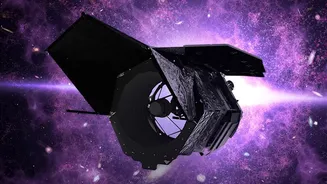
Rajendra Gupta, a physics professor at the University of Ottawa, has proposed a provocative alternative. His model calculates the universe's age to be 26.7 billion years, nearly double the standard estimate. This isn't just an arbitrary number; it's the result of a new cosmological framework called the CCC+TL model. This idea was partly motivated by recent observations from the James Webb Space Telescope (JWST), which has spotted galaxies in the early universe that appear surprisingly massive and mature. Under the standard 13.8-billion-year timeline, these 'impossible early galaxies' would have had very little time to form, posing a significant cosmic puzzle. Gupta's model suggests a simple solution: perhaps they just had more time.
Tired Light and Shifting Constants
Gupta's CCC+TL model combines two ideas, one old and one new. The 'TL' stands for 'tired light', a theory first proposed by Fritz Zwicky in 1929. It suggests that the redshift we observe from distant galaxies—the stretching of light that makes them appear redder—isn't just due to the expansion of space. Instead, 'tired light' theory posits that photons also lose energy as they travel across vast cosmic distances. Gupta's model merges this concept with the expanding universe, suggesting redshift is a hybrid phenomenon. The 'CCC' part stands for 'Covarying Coupling Constants'. This proposes that the fundamental forces of nature haven't been constant throughout time; their strengths may have weakened as the universe expanded. Together, these ideas paint a picture of a universe that doesn't necessarily need dark matter or dark energy to explain what we see.
What This New Model Could Explain
By nearly doubling the age of the universe, the CCC+TL model offers elegant solutions to a few thorny problems. Most notably, it resolves the 'impossible early galaxy problem'. In the standard model, a galaxy seen 300 million years after the Big Bang is truly in its infancy. But in Gupta's model, the universe would have already been several billion years old at that same point, giving galaxies ample time to grow large and complex. Furthermore, Gupta argues that the effects we attribute to dark matter and dark energy can be explained by his model's evolving physical constants and tired light. His team has tested the model against various observations, including the abundance of elements created after the Big Bang and the rotation of galaxies, and found it to be consistent.
A Challenge to Mainstream Science
While intriguing, the 26.7-billion-year model is far from being accepted science. It challenges decades of established cosmological theory and sits well outside the mainstream. The Lambda-CDM model has been successful at explaining a vast range of observations, from the cosmic microwave background to the large-scale structure of galaxies. For any new theory to replace it, it must explain all of that and more. Some of the work on the CCC+TL model is still awaiting peer review, and it has faced criticism for allegedly being inconsistent with certain datasets, though Gupta and his collaborators have disputed those claims. For now, the scientific community largely holds to the 13.8-billion-year age, even as it grapples with the puzzles that ideas like Gupta's aim to solve.