
Did you know Earth can have more than one moon? Our planet sometimes captures small asteroids, creating temporary 'mini-moons'. The latest example, dubbed 2026 QQ8, is a reminder of the dynamic and ever-changing nature of our cosmic neighbourhood.
What Exactly is a 'Mini-Moon'?
While
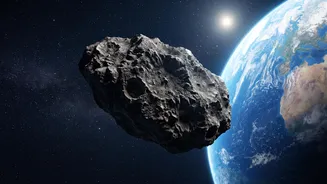
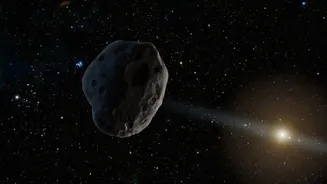
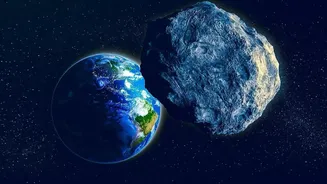
we all know and love our one permanent Moon, it's not always our only natural satellite. A 'mini-moon' is the informal name astronomers give to a small asteroid that gets temporarily snared by Earth's gravity. These objects don't stick around forever like our primary Moon. Instead, they perform a complex, looping dance around our planet for a few months or years before being flung back out into their own orbit around the Sun. Simulations suggest that at any given time, Earth likely has at least one of these companions, often about a metre across, but they are incredibly faint and fast-moving, making them very difficult to detect. Unlike our large Moon, which has a stable, predictable orbit, mini-moons follow chaotic, meandering paths.
The Story of 2026 QQ8
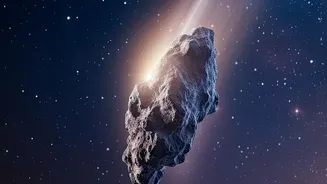
The object known as 2026 QQ8 is a perfect case study. Recent reports from late 2026 describe it as a tiny asteroid, roughly 2 meters (about 6 feet) in diameter, that was captured by Earth's gravity in April 2026. Its discovery, credited to Hungarian astronomer Krisztián Sárneczky in August, initially left scientists wondering if it was a natural object or a piece of old space junk. After careful observation to see how solar radiation affected its movement, it was confirmed to be a natural space rock. It poses no danger to us; even if it were on a collision course, a rock this small would simply burn up harmlessly in our atmosphere. It's expected to leave Earth's gravitational influence in early December 2026, continuing its journey around the sun.
The Delicate Dance of Capture and Escape
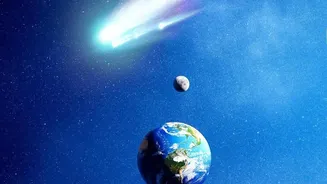
How does a planet capture a moon, even a temporary one? It's a matter of cosmic timing and a delicate gravitational balance. An asteroid orbiting the sun, with a path very similar to Earth's, might approach our planet at a relatively low speed. If it drifts close enough, it enters what's called Earth's 'sphere of influence,' where our planet's gravity becomes the dominant force acting on it. The combined gravitational pull of the Earth and the Moon can then 'catch' the asteroid, pulling it into a temporary, unstable orbit. However, the very forces that capture it, primarily the Sun's immense gravity, will eventually pull it away again. These objects are often caught and released near specific points of gravitational equilibrium between the Earth and Sun, known as Lagrange points.
Have We Seen This Before?
While the idea of a second moon sounds like science fiction, 2026 QQ8 is not the first of its kind to be observed. One of the first confirmed mini-moons was 2006 RH120, which orbited Earth for about a year between 2006 and 2007 before departing. Another famous example is 2020 CD3, a car-sized asteroid that was our temporary companion for about three years. These discoveries were made by dedicated sky surveys like the Catalina Sky Survey, which scan the skies for near-Earth objects. Each new discovery helps astronomers refine their understanding of this phenomenon and proves that Earth’s relationship with the asteroids in its neighbourhood is more intimate than we once thought.
Why These Tiny Visitors Matter
Beyond the simple curiosity factor, studying mini-moons offers huge scientific benefits. Because they have been gently captured, they are essentially pristine samples from the asteroid belt, delivered right to our cosmic doorstep. Studying them up close would be far easier and cheaper than sending a mission to the main asteroid belt between Mars and Jupiter. They could provide invaluable insights into what asteroids are made of and how our solar system formed. Some scientists even suggest that future missions could visit these temporary moons to test technologies for asteroid mining or planetary defence, all within a safe, close-to-home environment. They are natural testbeds for our future exploration of the solar system.