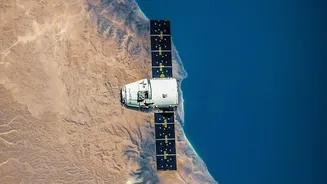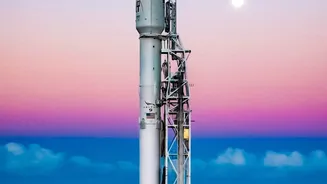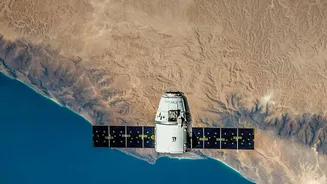







The insatiable appetite of artificial intelligence for energy and land is pushing Earth's resources to the limit. Now, SpaceX's chief is championing a radical solution that sounds like science fiction: moving data centers into orbit.
Why Earth Is Running Out of Room
The artificial intelligence
revolution runs on massive server farms called data centers. These digital factories consume staggering amounts of electricity for processing and cooling, and they also require vast tracts of land and water. In places like Texas, a major hub for tech expansion, the demand for power is already straining local grids, with hundreds of gigawatts of new connections requested. This has led to growing public and political resistance, with concerns over rising electricity bills and environmental impact creating what SpaceX's Elon Musk calls a 'high pitchfork level' for new data center projects on the ground. Facing permitting delays and regulatory headwinds, the very infrastructure needed for future AI development is hitting a terrestrial bottleneck.
The Orbital Solution
The proposed solution is to move this power-hungry infrastructure off the planet entirely. By placing data centers in orbit, they could be powered by constant, unfiltered sunlight. A solar panel in a sun-synchronous orbit can be vastly more productive than one on Earth, generating power almost continuously and drastically reducing the need for heavy battery storage. This approach bypasses earthly constraints entirely: no land use debates, no competition for water, and no tapping into strained terrestrial power grids. Musk has argued that within a few years, the cost of deploying AI computing in space could fall below that of ground-based facilities, making orbit the most compelling environment for future AI infrastructure.
An Astronomical Set of Challenges
Despite the bold vision, the engineering and economic hurdles are immense. The first is launch cost. While SpaceX's reusable rockets have lowered the price of getting to orbit, launching thousands of tons of server racks remains prohibitively expensive. Success hinges on the next-generation Starship vehicle dramatically reducing costs further. Another major obstacle is cooling. In the vacuum of space, there is no air for conventional cooling systems. Heat must be radiated away, likely using large, heavy radiator systems, which adds to launch mass and complexity. Finally, the hardware itself must be hardened to survive the harsh radiation environment of space, which can corrupt data and degrade electronics over time.
The Race for the High Ground Is On
SpaceX is not just talking; it is taking concrete steps. The company has filed for a trademark for an orbital data center service called 'Starmind' and has applied to launch a massive constellation of data_centric satellites. It has also begun testing the concept, launching satellites with AI chips from both NVIDIA and Google to see how they perform in orbit. Musk has stated that SpaceX, in partnership with NVIDIA, expects to begin launching the first Starmind computers as early as the third quarter of 2027, with plans to ramp up to significant volumes in 2028 and 2029. Other major players are also exploring the concept. Google's 'Project Suncatcher' is its own initiative to develop orbital computing, and it has already launched a test satellite with its custom TPU chips aboard a SpaceX rocket.
A New Class of Infrastructure
Orbital data centers are unlikely to replace their terrestrial counterparts entirely. Instead, they represent a new, specialized tier of infrastructure. They are ideal for certain workloads, such as processing vast amounts of data generated in space by Earth observation satellites, or for latency_tolerant tasks like AI model training. They could also provide a secure solution for sovereign data that must not cross national borders. This shift doesn't just represent a solution to an energy problem; it marks the potential beginning of a true in_space economy, where data processing happens close to where data is generated, be it from satellites monitoring our planet or future missions exploring others.