






What is Cosmic Sonification?
At its core, sonification is the process of translating data into non-speech audio. Think of it as the auditory equivalent of data visualization, where charts and graphs turn numbers into pictures. Instead of a graph, you get a soundscape. While we know
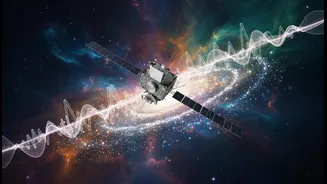
sound can't travel in the vacuum of space, scientists can take the vast amounts of digital data collected by telescopes—information about light, energy, and object density—and map it to audible properties like pitch, volume, and rhythm. This allows anyone to “listen” to astronomical images, from the chaotic heart of our galaxy to the delicate structures of a distant nebula.
How Does It Work?
NASA's Chandra X-ray Observatory has been a pioneer in this field, creating a library of cosmic sounds. To translate an image, scientists and sound designers decide how data points will correspond to sound. For example, in a sonification of the galactic center, data from different telescopes was assigned to different instruments: infrared data from the Spitzer telescope became a soft piano, optical data from Hubble was a plucky violin, and X-ray data from Chandra was represented by a glockenspiel. As a cursor sweeps across the image, the sounds play, allowing listeners to hear the different elements. Brightness might control volume, while the position of a star in the image could determine the pitch. This turns a static image into a temporal, evolving experience.
An Unexpected Boost for Visual Learners
Initially, a major goal of sonification was to make astronomy accessible to blind and low-vision communities, who are often excluded from a predominantly visual field. It has proven to be a powerful tool for this purpose, offering a faster way to understand the trends in a dataset than tactile graphs. But the surprise came when researchers noted the benefits for sighted individuals as well. While the concept of distinct 'learning styles' (visual, auditory, kinesthetic) is largely considered a myth, the power of multisensory learning is well-documented. Engaging multiple senses at once can lead to a deeper and richer understanding of complex information.
The Power of Multisensory Learning
Why does listening to an image help someone who learns best by seeing? The human auditory system is exceptionally good at detecting patterns, trends, and changes over time. When you listen to a sonified image, you're not just hearing a soundtrack; you're perceiving the data in a new dimension. This auditory information can highlight features that might be missed by the eye alone, reinforcing the visual data. For a visual learner, the sound provides another layer of information that confirms, clarifies, and solidifies what they are seeing. It helps create a more robust mental model of the object or phenomenon, turning abstract data into something more intuitive and memorable.
The Future of Hearing the Universe
Cosmic sonification is more than just a novelty; it's a growing field with immense potential for science communication, education, and even research. Projects are underway to create more multisensory astronomy activities for schools and the public. As the tools become more sophisticated, scientists themselves may use sonification to notice subtle patterns in massive datasets that are difficult to spot visually. By combining our most powerful senses, we not only make science more inclusive but also open up new avenues for discovery. The universe has always been full of wonders to see, and now, we are finally learning how to listen.