




The World’s Largest Telescope
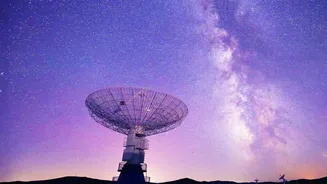
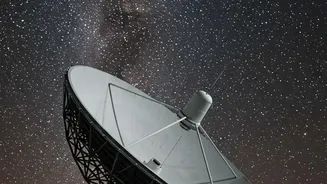
The Square Kilometre Array (SKA) isn't a single telescope but a globe-spanning scientific instrument of unprecedented scale. Split across two remote, radio-quiet deserts, it consists of two separate arrays working in unison. In South Africa's Karoo region,
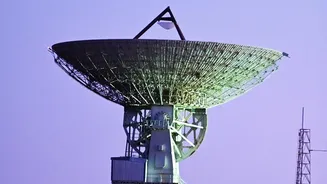
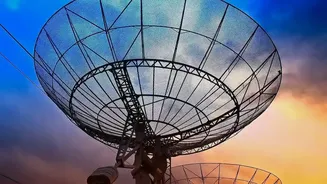
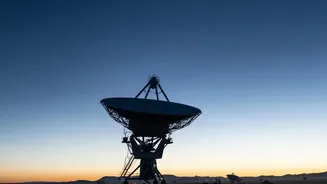
nearly 200 traditional dish antennas (known as SKA-Mid) are being deployed. Meanwhile, in Western Australia, over 130,000 smaller, Christmas tree-like antennas (called SKA-Low) are dotting the landscape. The name refers to its ultimate ambition: a total collecting area of one square kilometre. This international megaproject, with its headquarters in the UK, is one of the most significant scientific endeavours of the 21st century, with construction having officially started in late 2022.
Listening to the 'Cosmic Dawn'
The "cosmic echoes" the SKA seeks are not sound but faint radio waves that have travelled for over 13 billion years. They originate from a period known as the Cosmic Dawn and the subsequent Epoch of Reionization. After the Big Bang, the universe was a dark, neutral sea of hydrogen gas. Hundreds of millions of years later, the very first stars and galaxies began to form, their intense radiation heating and ionizing the surrounding gas. This transition left a faint but specific signature in the form of radio emissions from that primordial hydrogen, known as the 21cm signal. Optical telescopes like Hubble or Webb can't see this period clearly because the neutral gas absorbs visible light. The SKA, however, is designed to detect these incredibly faint, redshifted radio waves, effectively allowing astronomers to create the first maps of the universe as it was lighting up.
The Power of Many Dishes
So how does it achieve this? The SKA's power comes from a technique called interferometry. Instead of building one impossibly large dish, astronomers connect thousands of smaller antennas together with fibre optic cables. When a faint radio wave from deep space arrives, it hits each antenna at a slightly different time. By precisely combining these signals in a supercomputer, the array can function as one virtual telescope with a diameter equal to the largest distance between the antennas—up to 150 kilometres for SKA-Mid. This allows for incredibly high-resolution images, sharp enough to spot details in objects billions of light-years away. The more antennas in the array, the more sensitive it is, enabling it to pick up the whispers of the early universe from beneath much louder cosmic noise.
A Data Tsunami
Capturing these signals is only half the battle. The sheer volume of data the SKA will generate is a monumental business and engineering challenge. The raw data flowing from the antennas will exceed the entire internet's current traffic, creating petabytes of information every day. This data must be transported, stored, and processed. To handle this digital deluge, the project includes two of the world's most powerful supercomputers, located in Cape Town and Perth. These science data processors will perform around 135 petaflops—135 quadrillion calculations per second—to correlate the signals and turn them into usable scientific images and data products. To prepare the global science community for this new era, the SKA Observatory has been running 'Data Challenges', simulating the massive datasets to help researchers develop the skills and software needed to make discoveries.