
The Tyranny of the Rocket Equation
For decades, space travel has been dictated by a simple, brutal principle known as the rocket equation. In essence, to go faster or farther, a rocket needs more fuel. But that fuel has mass, which means you need even more fuel just to lift the initial
fuel off the ground. This creates a cycle of diminishing returns, making missions to the outer solar system and beyond incredibly complex and expensive. Conventional rockets provide immense power in short bursts, which is perfect for escaping Earth's gravity, but they quickly run out of propellant and then coast for years. This fundamental limitation has kept the farthest reaches of our cosmic neighborhood tantalizingly out of easy reach.
Sailing on Beams of Light
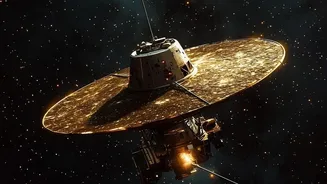
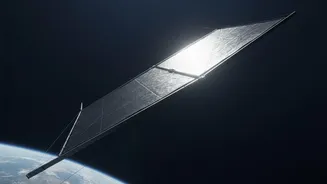
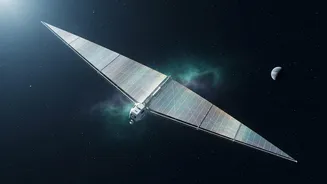
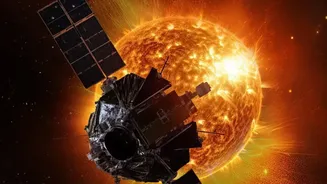
Solar sails offer an elegant escape from this fuel-dependent trap. A solar sail works much like a sailboat on the ocean, but its 'wind' is sunlight itself. Sunlight is composed of particles called photons. While photons have no mass, they carry momentum. When these countless particles strike a large, reflective sail—often made of an ultra-thin material like Mylar—they transfer their momentum, giving the spacecraft a tiny, continuous push. It's not the solar wind, which is a stream of charged particles, but the pressure of light itself that does the work. Each push is minuscule, but in the frictionless vacuum of space, they add up.
The Unfair Advantage: Infinite Propulsion
Herein lies the magic of solar sailing: the fuel is infinite and everywhere, at least within the solar system. Unlike a chemical rocket that fires for minutes, a solar sail accelerates constantly for months or even years. The initial thrust is incredibly gentle, but this continuous acceleration allows a solar sail probe to eventually reach speeds far greater than a conventional spacecraft could achieve. Because it doesn't need to carry any fuel, the spacecraft can be much lighter, making it cheaper to launch. This concept of having an infinite specific impulse—a measure of engine efficiency—is what positions solar sailing as a game-changer for long-duration missions.
From Science Fiction to Proven Technology
This isn't just a theoretical concept. The technology has been proven by several successful missions. Japan's IKAROS probe became the first to successfully demonstrate solar sailing in interplanetary space in 2010. More recently, The Planetary Society's crowdfunded LightSail 2 mission, which ended in 2022, proved that a small satellite could use a solar sail to change its orbit around Earth. Building on this, NASA launched the Advanced Composite Solar Sail System (ACS3) in 2024 to test new composite booms, which are critical for deploying the even larger sails needed for future deep-space missions. These missions are paving the way for more ambitious applications.
Challenges on the Cosmic Horizon
Of course, the technology is not without its challenges. The gentle push from sunlight means solar sails are not useful for launching from a planet's surface; they must be deployed in orbit. The sails themselves must be massive yet lightweight and durable enough to withstand years of solar radiation. Navigation is also complex, requiring precise angling of the sail to steer the spacecraft, much like tacking a sailboat against the wind. Furthermore, the thrust diminishes as the spacecraft travels farther from the Sun, making it less effective in the outer solar system.
The Future is Bright and Boundless
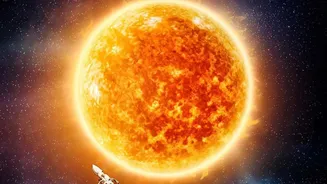
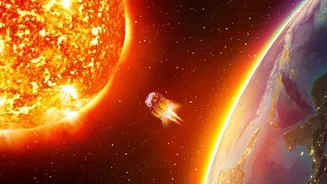
Despite the hurdles, the future of solar sailing is incredibly bright. NASA and NOAA are exploring large-scale sails for missions that could provide earlier warnings for solar storms by placing observatories in unique orbits. Some concepts, known as 'extreme solar sailing,' involve sending probes on a close slingshot around the sun to achieve incredible speeds, potentially reaching the outer planets in months rather than years. Looking even further ahead, scientists envision using powerful ground-based lasers to push on sails, a concept called 'beamed sailing'. This could overcome the distance limitation of sunlight and propel probes to other star systems, finally opening the door to interstellar travel.