








Earth’s Deep, Unseen Boundary
Deep inside Earth, about 2,900 kilometres below the surface, lies a boundary of immense scientific interest. It's a surprisingly thin and uneven layer called the D-double-prime layer, or D". It sits right where the solid, rocky mantle meets the molten,
liquid iron outer core. Think of it not as a clean line, but as a complex, messy transition zone. It varies in thickness from place to place and is defined by dramatic changes in temperature and density. This is the planet's ultimate thermal boundary, the place where heat from the scorching core begins its journey up through the mantle. This process is fundamental to the geodynamo effect, which generates Earth's protective magnetic field. Scientists believe the D" layer is also the birthplace of mantle plumes—hot columns of rock that rise to the surface to create volcanic hotspots like Hawaii—and the final resting place for tectonic plates that have subducted back into the planet.
The Sun's Furious Engine Room
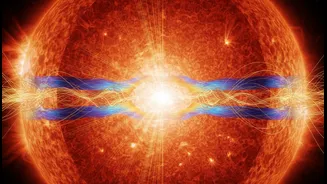
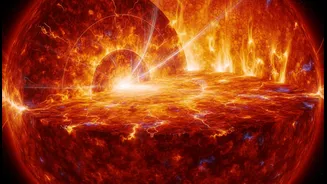
Just as Earth has distinct internal layers, so does the Sun. At its centre is the core, where nuclear fusion occurs. Above that is the vast radiative zone, where energy travels as photons in a journey that can take thousands of years. The outermost interior layer is the convection zone, a turbulent region of roiling plasma that carries heat to the surface. Between the calm, solidly rotating radiative zone and the chaotic, differentially rotating convection zone lies a remarkably thin shear layer: the tachocline. Discovered through helioseismology (the study of the Sun's vibrations), the tachocline is only about 4% of the Sun's radius thick, yet it's a place of incredible turmoil. Here, the rotation speed changes abruptly, creating a massive shear force.
What is the Tachocline?
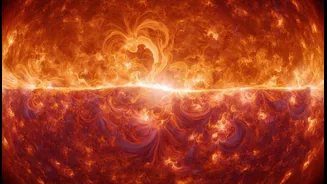
The tachocline's primary importance is its role as the seat of the solar dynamo. The Sun doesn't rotate as a solid ball; its equator spins faster than its poles. The convection zone carries this differential rotation, while the radiative zone below it rotates as a single, rigid body. The tachocline is the boundary where these two different rotational styles meet and grind against each other. This intense shearing action is believed to stretch and amplify the Sun's magnetic field lines, transforming weaker fields into the immensely powerful ones that drive solar activity. This process is thought to be the engine behind the 11-year solar cycle, sunspots, and massive solar flares that can impact us here on Earth.
A Tale of Two Boundary Layers
At first glance, a rocky layer inside Earth and a plasma layer inside a star seem worlds apart. Yet, the D" layer and the tachocline serve as a powerful analogy for why thin boundaries matter in complex systems. Both are transitional zones where materials in different states and with different behaviours interact intensely. Earth's D" is where the solid silicate mantle meets the liquid iron core, while the Sun's tachocline is where the rigidly rotating radiative zone meets the differentially rotating convective zone. In both cases, these thin layers have an outsized influence on the entire system. The D" layer helps regulate heat flow from the core and influences surface geology, while the tachocline is considered the origin point for the Sun's magnetic field and its cycles of activity. They are not passive dividers but active, dynamic regions where critical physical processes take place.
Why the 'In-Between' Matters
The comparison highlights a fundamental principle in nature: interfaces are often where the most interesting and important things happen. On Earth, we see this in our own atmosphere's planetary boundary layer—the thin, turbulent zone near the surface that governs weather and air quality. In planets and stars, these internal boundaries act as engines of change. The D" layer’s unique chemical and thermal properties, possibly influenced by a cosmic collision in Earth's deep past, are crucial for understanding everything from volcanism to the magnetic shield that protects us from solar radiation. Similarly, the intense shear of the tachocline is the key to the Sun's magnetic personality. Understanding these thin, hidden layers is therefore not just an academic exercise; it's essential for comprehending the evolution and behaviour of our planet and our star.