








What Exactly Is Aphelion?
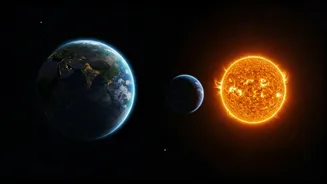
Let’s start with the basics. Earth’s orbit around the sun isn't a perfect circle; it’s a slight oval, or an ellipse. This means our distance from the sun changes throughout the year. Aphelion is the specific point in our orbit when we are farthest away
from the sun. The term comes from the Greek words 'apo' (away) and 'helios' (sun). The opposite event, when Earth is closest to the sun, is called perihelion, which happens in early January. On July 6, 2026, Earth will reach aphelion, placing it about 152.1 million kilometres from our star. That's roughly five million kilometres farther than it is during perihelion.
The Great Seasons Myth
It’s a common and logical assumption: we are closer to the sun in the summer and farther away in the winter. But aphelion proves this is incorrect for the Northern Hemisphere. We hit our maximum distance from the sun right in the middle of summer. So, if distance isn’t the reason for the seasons, what is? The answer lies not in our orbital path, but in our planet’s posture. Earth is tilted on its axis by about 23.5 degrees. This tilt is the true driver of the seasons.
It’s All About the Tilt
Imagine the Earth spinning like a top that’s leaning to one side. As we orbit the sun, that tilt means different parts of the planet get more direct sunlight at different times of the year. During the Northern Hemisphere’s summer, the North Pole is tilted toward the sun. This orientation means the sun's rays hit this part of the world more directly, like a flashlight shining straight down on a surface. This direct energy is more concentrated, leading to more heat. Additionally, the tilt gives us longer daylight hours, allowing more time for the sun to warm the land and atmosphere. When the Northern Hemisphere is tilted away from the sun, the rays strike at a lower angle, spreading the energy out and resulting in the cooler temperatures of winter.
A Tale of Two Hemispheres
Of course, the seasons are reversed for the Southern Hemisphere. When it’s summer in India, it’s winter in Australia. This is because as the Northern Hemisphere tilts towards the sun, the Southern Hemisphere is tilted away. Interestingly, because the Earth is at its closest point to the sun (perihelion) during the Southern Hemisphere's summer, their summers receive slightly more intense solar radiation. However, the Northern Hemisphere’s summers are, on average, slightly warmer. This is because the Northern Hemisphere has more landmass, which heats up more easily than the vast oceans of the south.
A Cosmic Curiosity
While aphelion doesn't cause our summer heat, the 7% decrease in solar radiation we receive at this distance likely moderates Northern Hemisphere summers, preventing them from being even hotter. Conversely, the extra intensity at perihelion makes Southern Hemisphere summers a bit more intense than they would be otherwise. This whole phenomenon is a fantastic reminder that our experience on Earth is shaped by a delicate dance of cosmic factors. The slight wobble, the gentle tilt, and the not-quite-circular path all combine to create the world we know.