






A Planet Seven Times Bigger Than Its Star
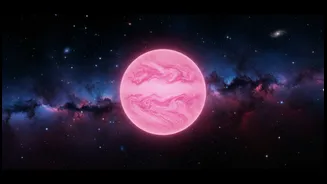
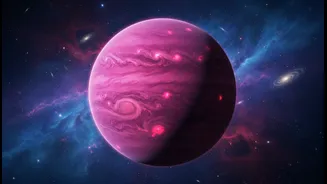
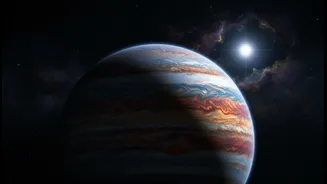
Meet WD 1856 b, a gas giant roughly the size of Jupiter, located about 80 light-years from Earth. Its story is a cosmic paradox. It orbits a white dwarf, the dense, Earth-sized core left behind after a Sun-like star dies. The planet is so close to this
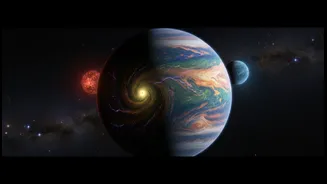
stellar corpse that it completes an orbit every 34 hours. This proximity creates a mind-bending visual: a planet that is seven times wider than the star it circles. If it were in our solar system, it would be orbiting well inside the path of Mercury. This arrangement presents a huge problem for astronomers, because by all conventional models of stellar evolution, this planet should have been destroyed long ago.
The Engulfment Problem
For most stars like our Sun, the end is a dramatic, all-consuming event. In about five billion years, our Sun will exhaust its primary fuel source, hydrogen, and swell into a red giant. In this phase, it will expand to more than 100 times its current size, engulfing its innermost planets — Mercury, Venus, and almost certainly Earth. Any planet in such a star’s path is expected to be incinerated. The star that WD 1856 b orbits went through this exact process. It would have expanded far beyond the planet’s current orbit, meaning WD 1856 b faced and somehow cheated a fiery death sentence. The big question for scientists has been, how?
A Clue from Faint, Leftover Heat
The latest clues come from the powerful James Webb Space Telescope (JWST). An international team of astronomers used Webb to observe the planet as it passed in front of its tiny star. In doing so, they detected the first-ever atmosphere on a planet orbiting a white dwarf, finding signs of methane and haze. More importantly, they measured the planet's temperature. It was significantly warmer than could be explained by the faint light of its dead star. This faint, leftover heat was the smoking gun, suggesting the planet underwent a violent, heat-generating event in its past to get to where it is today.
The Great Migration
The JWST data strongly supports a fascinating theory: WD 1856 b didn't survive its current close orbit; it survived by not being there in the first place. The leading hypothesis is that the planet originally had a wide, safe orbit, far from its star. It remained there for billions of years while the star went through its red giant phase and collapsed into a white dwarf. The system it belongs to is actually a triple-star system. Scientists believe gravitational nudges from the two other distant companion stars eventually destabilized the planet’s orbit, sending it on a long, inward spiral toward the white dwarf. The intense gravitational forces during this migration would have stretched and heated the planet, explaining the residual warmth Webb detected.
A Glimpse of Our Own Future
The story of WD 1856 b is more than just a cosmic curiosity; it's a potential preview of our own solar system's distant future. While Earth's fate seems sealed, the destiny of our own gas giants, Jupiter and Saturn, is less certain. This discovery provides the first real-world evidence of how a planetary system can reorganize itself after its star dies. It suggests that even after a sun is gone, planets can continue on dramatic journeys, reshaped by the complex gravitational dance of their stellar neighborhoods. The impossible survival of one planet has opened up a whole new field of study into the long-term evolution of planetary systems.