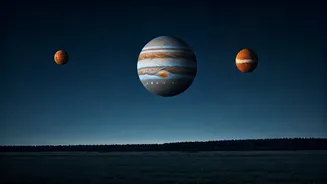




A Celestial Trio Greets the Evening
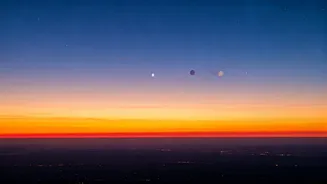
For the next few weeks, three of our solar system’s most captivating planets—Jupiter, Mars, and Saturn—are putting on a special show in the evening sky. This isn’t a rare, once-in-a-lifetime alignment, but rather a beautiful and easily accessible opportunity
to connect with the cosmos. Each planet offers a distinct personality: one brilliantly outshines every star, another glows with a fiery red hue, and the third offers a steady, quiet light. For city dwellers and seasoned stargazers alike, this is the perfect excuse to step outside, take a breath, and enjoy the grand spectacle playing out millions of kilometres away.
Jupiter: The Dazzling King of Planets
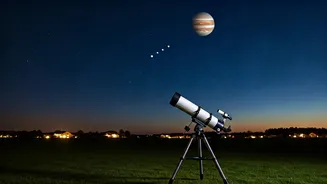
Your first and easiest target is Jupiter. You can’t miss it. Look towards the eastern sky shortly after sunset, and you will spot an unblinking, intensely bright point of light that far outshines any other star in its vicinity. That’s the gas giant. Jupiter is so bright because of its enormous size and its thick, reflective cloud cover. It acts like a giant mirror, bouncing sunlight back at us. Even with a simple pair of binoculars, you might be able to spot a tiny secret: up to four of its largest moons (Io, Europa, Ganymede, and Callisto) appearing as tiny pinpricks of light huddled close to the planet. Seeing these moons for yourself is a thrilling experience, echoing Galileo’s own discovery centuries ago.
Mars: The Fiery Red Wanderer
Once you’ve found Jupiter, cast your gaze higher up in the sky to find Mars. The Red Planet is easily identifiable by its distinct, rusty tint. It won’t be as dazzlingly bright as Jupiter, but its colour makes it stand out against the backdrop of white and blue stars. This reddish hue comes from the iron oxide—essentially rust—that covers its surface. For millennia, this colour has associated Mars with fire, war, and passion in cultures around the world. As it journeys across our sky, Mars offers a constant, colourful reminder of the diverse and dynamic worlds that share our solar system. Its steady glow is a beacon for our own curiosity about what lies beyond Earth.
Saturn: The Steady, Golden Jewel
The final member of our trio is the magnificent ringed planet, Saturn. It will be the faintest of the three, so you’ll need to let your eyes adjust to the darkness to spot it. Look for a steady, yellowish-white point of light, not too far from Jupiter. Unlike twinkling stars, Saturn will shine with a calm, unwavering glow. While you won’t be able to see its famous rings with the naked eye, knowing they are there adds a layer of magic to the experience. The light you’re seeing left Saturn over an hour ago to reach your eyes. It’s a stable, distant giant, a reminder of the scale and majesty of our cosmic neighbourhood. Spotting its gentle light is a rewarding challenge for any aspiring sky-watcher.
Your Guide to a Perfect Viewing
You don't need special equipment, but a few tips can enhance your experience. First, timing is everything. The best window is about 45 to 90 minutes after sunset, when the sky is dark enough for the planets to pop but before they drift too low. Second, escape city lights if you can. Even a local park, a rooftop, or a balcony facing away from major streetlights can make a huge difference. Give your eyes at least 10 minutes to adapt to the darkness. While all three planets are visible to the naked eye, a pair of binoculars will make Jupiter’s moons and the colours of Mars and Saturn more vivid. For an extra hand, download a free stargazing app like Stellarium or Star Walk. Just point your phone at the sky, and the app will identify everything for you.