
Catching a Planet's Shadow
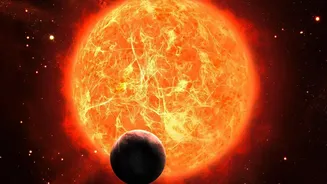
The primary technique begins with a simple, yet powerful, observation method known as the 'transit method'. Imagine watching a bright lamp from a distance. If a tiny moth flies in front of it, you’ll see a slight, temporary dip in the lamp's brightness.
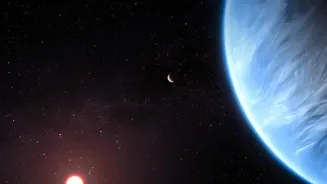
Astronomers do the same with stars. They stare at a star and wait for an orbiting planet to pass in front of it, an event called a transit. This transit causes a minuscule and brief dimming of the star's light. By measuring this dip, scientists can not only confirm the planet's existence but also determine its size. While this method requires the planet's orbit to be perfectly aligned from our point of view, it is the crucial first step to peeking into its atmosphere.
Reading a 'Barcode' in Starlight
This is where the real magic, called transmission spectroscopy, happens. When a planet with an atmosphere transits its star, a tiny fraction of the starlight filters through that atmospheric layer. As the light passes through, gases in the planet’s atmosphere absorb very specific colours, or wavelengths, of that light. Each gas or chemical compound has a unique absorption signature, like a chemical fingerprint or a supermarket barcode. When astronomers on Earth collect the starlight that has passed through the atmosphere, they can split it into a rainbow of colours called a spectrum. By looking for the dark bands where light is missing, they can identify precisely which gases are present in that alien sky.
The Tools for the Job
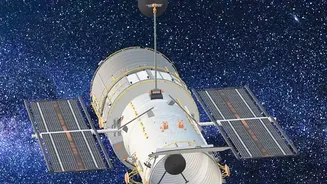
This kind of precision work requires incredibly powerful tools. For years, the Hubble Space Telescope pioneered this technique, giving us our first tentative glimpses into these distant atmospheres. However, the game changed completely with the launch of the James Webb Space Telescope (JWST). JWST is designed to see the universe in infrared light, which is invisible to the human eye but perfect for detecting the signatures of key molecules. Its massive mirror and extreme sensitivity allow it to capture these faint atmospheric 'barcodes' with unprecedented clarity, turning what was once a monumental challenge into a new era of discovery. JWST has already provided detailed breakdowns of exoplanet atmospheres, identifying specific gases and even signs of active chemistry and clouds.
Hunting for Signs of Life
The ultimate goal of studying exoplanet atmospheres is to find biosignatures—gases that could indicate the presence of life. On Earth, life produces a host of gases, with the most prominent being oxygen, methane, and ozone. Finding these in the atmosphere of a rocky, Earth-sized planet in the 'habitable zone'—the region where liquid water could exist—would be a monumental discovery. However, context is crucial. Many of these gases can also be produced by non-biological processes, so scientists are cautious. For instance, a planet could have oxygen without life if intense starlight broke down water molecules in its atmosphere. The most compelling evidence would be finding a combination of gases that are out of balance, such as methane and oxygen co-existing, as these would normally destroy each other without a constant biological source to replenish them.