




The Problem with Rocket Fuel
Every spacecraft ever sent to the outer planets has been at the mercy of the rocket equation. In simple terms, to go faster or farther, a rocket needs more fuel. But that fuel has mass, which requires even more fuel to launch and propel it. This fundamental
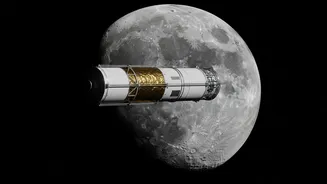
constraint makes missions incredibly expensive and limits how much we can carry and how fast we can get there. Chemical rockets provide a powerful initial burst of thrust but then coast for most of their journey. This system is effective for getting into orbit or for short trips, but it makes journeys to the outer solar system long and missions to other stars practically impossible with current technology. To truly explore the cosmos, we need a way to break free from the need to carry our own propellant.
How to Sail on Sunshine
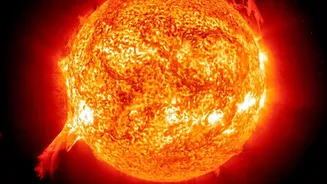
A solar sail works much like a sailboat uses wind, but its driving force is sunlight itself. Light is made of particles called photons which, despite having no mass, carry momentum. When these photons strike a large, reflective surface in the vacuum of space, they transfer that momentum, giving the sail a tiny, continuous push. While this force is incredibly gentle—at Earth's distance from the sun, the pressure on a massive sail is only about as much force as the weight of a paperclip—it is constant. Unlike a rocket that burns out, a solar sail accelerates continuously as long as it is exposed to light. Over weeks and months, this constant acceleration can allow a spacecraft to reach speeds far greater than what chemical rockets can achieve.
Engineering an Ultra-Thin Future
The key to an effective solar sail is making it enormous yet incredibly lightweight and durable. Recent tests are focusing on new materials and construction techniques to achieve this. Engineers are moving beyond traditional materials like Mylar and polyimide, which were used in early demonstration missions like The Planetary Society's LightSail 2. NASA’s Advanced Composite Solar Sail System (ACS3), launched in 2024, is testing lightweight carbon fiber booms designed to support sails far larger than previous versions. Other research involves even more exotic materials like graphene, a one-atom-thick sheet of carbon that is incredibly strong and light. In 2026, NASA awarded a contract to the company Opterus to develop a deployment system for a 1,600-square-meter sail, roughly the size of a hockey rink, demonstrating a massive leap in scale.
New Frontiers and Unlocked Potential
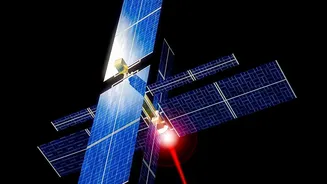
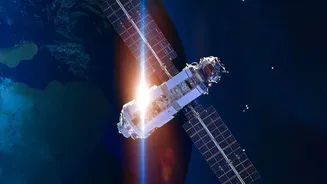
This technology doesn't just promise faster travel; it enables entirely new types of missions. Solar sails could allow spacecraft to hover in unique orbits that would otherwise be unstable, such as positioning a solar-storm-warning satellite closer to the sun than is currently possible. They could be used for long-duration missions to observe the poles of the sun or Earth, or to conduct flybys of multiple asteroids in a single trip. Some designs even propose using powerful lasers from Earth to push tiny "nanocraft" on sails toward nearby stars, potentially cutting travel time from tens of thousands of years to just a few decades. The technology also has more practical applications closer to home, such as using smaller sails to help de-orbit old satellites and reduce space debris.