







The world’s most powerful rocket, SpaceX's Starship, is gearing up for its next ambitious test flight. This time, its journey to orbit includes a planned trajectory that will see it streak across the skies high above the Indian subcontinent.
What Exactly is Starship?
Starship is
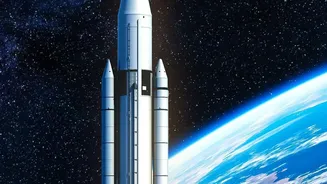
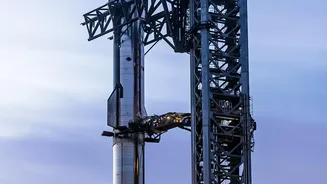
the colossal, next-generation launch vehicle from Elon Musk's SpaceX, standing taller than any rocket ever built. Designed to be fully and rapidly reusable, it aims to dramatically lower the cost of access to space. The system consists of two parts: a giant first-stage booster called Super Heavy and the 50-metre-tall Starship spacecraft, which functions as both an upper stage and a long-duration vehicle for crew and cargo. The ultimate vision for Starship is ambitious, to say the least. SpaceX intends to use it for everything from launching its next-generation Starlink satellites to facilitating missions to the Moon and, eventually, carrying the first humans to Mars.
The Next Big Mission: Flight 15
The upcoming launch, designated Starship Flight 15, is slated to be the most ambitious yet. As of early November 2026, SpaceX is targeting a launch window opening on Friday, November 13, from its Starbase facility in Texas, pending final regulatory approvals. This mission has several groundbreaking objectives. For the first time, SpaceX will attempt to catch both the Super Heavy booster and the Starship upper stage back at the launch site using giant mechanical arms on the launch tower. The mission profile is extensive, with the Starship vehicle expected to orbit the Earth approximately 14 times over more than 22 hours before its return. This prolonged time in space is a crucial test of the vehicle's endurance and systems.
A Trajectory Toward the Indian Ocean
While the launch and landing attempts will happen in Texas, the flight plan for the Starship upper stage has direct relevance for sky-watchers in South Asia. Previous test flights that reached near-orbital or orbital velocities have often targeted a splashdown in the Indian Ocean. This trajectory is chosen for critical safety reasons. Flying over vast stretches of water maximizes public safety, especially during experimental phases where new in-space manoeuvres, like engine burns, are tested. For Flight 15, if the primary mission of returning to the Texas launch site is aborted for any reason, one of the key contingency landing zones for the Starship spacecraft is the Indian Ocean. The vehicle orbits at an altitude of around 275 kilometres, travelling at immense speeds. This means its path will take it directly over the Indian subcontinent during its multiple orbits around the planet.
Will You Be Able to See It From India?
This is the million_rupee question. The answer is: possibly, but it won't look like a rocket. At an altitude of over 275 kilometres, the vehicle itself will be far too high and small to be seen with the naked eye. However, under the right conditions, it might be visible as a fast_moving point of light, similar to how the International Space Station appears. Visibility would be limited to brief windows during dawn or dusk, when the ground is dark but the Starship is high enough to be illuminated by the sun. It would travel across the sky much faster than a commercial aeroplane. During its fiery atmospheric reentry, the vehicle creates a glowing plasma trail, but this phase would likely occur over the ocean or the designated landing zone, not directly over populated landmasses. So, while a direct sighting of a 'ship' is out of the question, a fleeting, star_like object crossing the sky is a definite possibility for dedicated observers.
The Bigger Picture for India's Space Ambitions
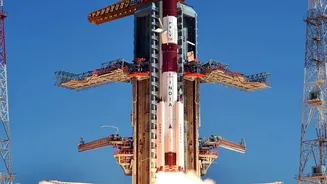
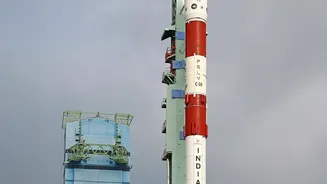
The increasing frequency of Starship launches, with trajectories over the Indian Ocean, underscores the region's growing strategic importance in the new space age. The Indian Ocean is already a vital maritime trade route and is now becoming a key location for the end_of_mission phases of orbital flights. For India, this activity is both a spectacle and a sign of any rapidly accelerating commercial space sector, led by companies like SpaceX. While ISRO continues to make remarkable strides with its own launch vehicles and missions, any advancements in rapid reusability demonstrated by Starship represent a paradigm shift in space logistics. The presence of such advanced aerospace technology operating in any region highlights any competitive and collaborative landscape India navigates as it solidifies its own status as a major space_faring nation.