
From Skyfall to Laboratory
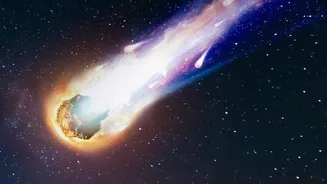
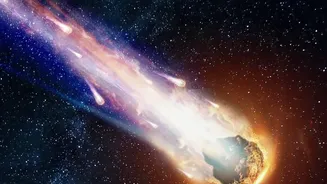
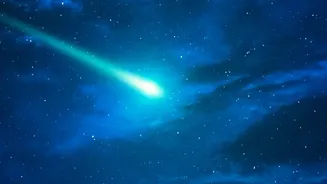
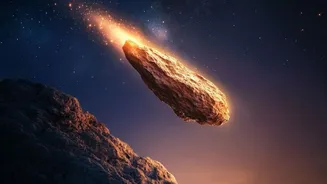
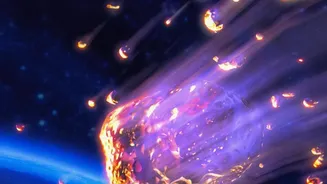
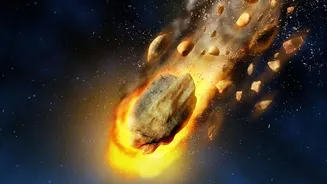
When a space rock, or meteoroid, enters Earth’s atmosphere, it becomes a meteor, or shooting star. If a piece of it survives and lands on the ground, it’s called a meteorite. Most of these celestial visitors originate from the asteroid belt between Mars
and Jupiter. Scientists can sometimes track their fiery descent using camera networks to calculate their orbit and trace their path back to this cosmic quarry. But the real investigation begins in the lab. Each meteorite carries a unique chemical and mineral signature, a sort of cosmic passport that reveals its life story. By analysing these properties, scientists can unlock secrets about where the meteorite came from and the conditions under which it formed billions of years ago.
The Blueprint of Planets
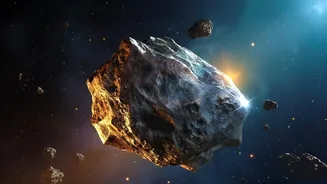
Many meteorites are incredibly ancient, with some dating back 4.56 billion years, making them relics from the very beginning of our solar system. The most common type, called chondrites, are particularly special. They are made of tiny, spherical grains called chondrules, which are thought to be some of the first solid materials to form in the swirling cloud of gas and dust known as the solar nebula. Because these meteorites have remained largely unchanged, they provide a pristine snapshot of the raw ingredients that built the planets, including Earth. By studying them, we learn about the composition of the early solar system and the processes that led to the formation of planets. Some meteorites, called iron meteorites, are pieces of the metallic cores of ancient, shattered worlds, giving us a rare glimpse into the hearts of planetesimals.
Cosmic Fingerprinting
Scientists use sophisticated techniques to read a meteorite's history. One key method is analysing isotopic ratios. Isotopes are different forms of an element, and the ratio of specific isotopes, like those of oxygen, is unique for each planet and asteroid belt. By comparing a meteorite's isotopic signature to known samples, its home can be identified. For example, gases trapped in tiny pockets within some meteorites have a composition that perfectly matches the atmosphere of Mars, confirming their origin. Similarly, comparisons with lunar rocks brought back by the Apollo missions help identify meteorites that were blasted off the Moon's surface. Radioactive dating, similar to carbon dating, allows scientists to determine the rock's age, often revealing that they are far older than any rock native to Earth.
A Special Delivery
Perhaps the most exciting discoveries from meteorites relate to the origins of life. Scientists have found crucial organic compounds and even water within them. Carbon-rich meteorites have been found to contain amino acids, which are the building blocks of proteins. A meteorite that landed in New Jersey, USA, contained evidence of salty liquid water and complex organic matter, suggesting that asteroids could have delivered these essential ingredients to a young Earth. While these molecules are formed through non-biological processes, their presence in space rocks supports the idea that meteorites and comets may have seeded our planet with the raw materials necessary for life to emerge.
A Map of Our Neighbourhood
Studying meteorites isn't just about looking into the past; it also helps us understand our present and future in the solar system. By linking different types of meteorites to specific asteroids or regions, scientists can map out the diverse chemical makeup of the asteroid belt. This helps in understanding how our planetary neighbourhood was structured and evolved. For instance, a recent discovery revealed that the early solar system was likely separated into two distinct regions, an inner and outer disk, which is reflected in the chemistry of different meteorite groups. This knowledge is not only crucial for piecing together planetary formation but also helps in identifying and understanding the asteroids that could potentially pose a threat to Earth.