



A New Cosmic Atlas
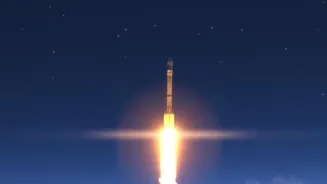
Launched on August 30, 2026, the Nancy Grace Roman Space Telescope is NASA's next great observatory, named after the agency's first chief of astronomy. While past telescopes have offered deep, narrow glimpses into space, Roman is designed for sweeping
cosmic surveys. It has a primary mirror the same size as the Hubble Space Telescope's—2.4 meters in diameter—but its groundbreaking optical design gives it a field of view at least 100 times larger. This means that in a single snapshot, Roman can capture an area of the sky that would require 100 separate images from Hubble. This capability will allow it to survey the universe up to 1,000 times faster than its celebrated predecessor, fundamentally changing the speed and scale of astronomical research.
Shedding Light on Dark Mysteries
Two of the biggest puzzles in modern cosmology are dark energy and dark matter, invisible components that are believed to make up about 95% of the universe. Roman's primary mission is to tackle these mysteries head-on. Dark energy is the force thought to be causing the universe's expansion to accelerate, while dark matter is the unseen mass whose gravitational pull holds galaxies together. By mapping the locations and distances of billions of galaxies, Roman will create vast 3D maps of the cosmos. These maps will allow scientists to study how the distribution of galaxies has changed over cosmic history, providing crucial clues about the competing push and pull of dark energy and dark matter. The telescope will use multiple methods, including observing stellar explosions called supernovae and a phenomenon known as gravitational lensing, where massive objects bend the light from galaxies behind them.
A Census of Unseen Worlds
Beyond cosmology, Roman is set to revolutionize the hunt for exoplanets—planets outside our solar system. While previous missions have found thousands of planets, they have been biased toward finding large planets orbiting very close to their stars. Roman will primarily use a technique called gravitational microlensing. This method detects planets by observing the way a foreground star's gravity magnifies the light from a more distant background star. A planet orbiting the foreground star creates a distinct, secondary brightening effect. Because this technique is sensitive to planets of various sizes and orbits, it is ideal for finding worlds farther from their stars, including analogs to the planets in our own solar system. Astronomers anticipate that Roman will discover thousands of new exoplanets, from rocky worlds to ice giants, and may even find rogue planets that wander through the galaxy without a host star.
A Complement to Webb and Hubble
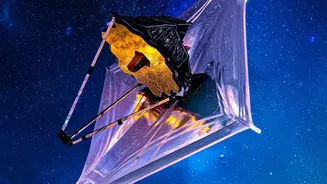
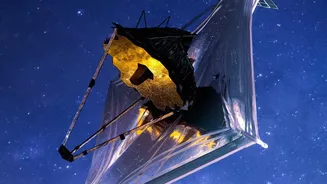
Roman is not a replacement for telescopes like Hubble or the James Webb Space Telescope (JWST), but a powerful complement. While Webb and Hubble act like zoom lenses, capturing incredibly detailed data from small patches of the sky, Roman functions as a wide-angle lens, providing the bigger picture. Roman will rapidly survey huge areas, identifying rare and interesting objects for other telescopes to investigate in greater detail. For instance, Roman could discover thousands of new targets, which Hubble could then examine in ultraviolet and visible light or Webb could study in deeper infrared. This synergy will create a more complete picture of the universe, combining Roman's panoramic maps with the high-resolution close-ups of its companions. This new observatory will generate an enormous amount of information—about 1.4 terabytes of data every day—creating a rich archive for astronomers worldwide to explore for decades to come.