




Meet the Stellar Nursery
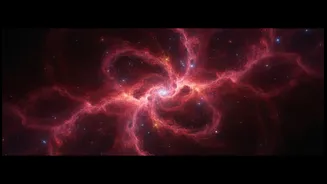
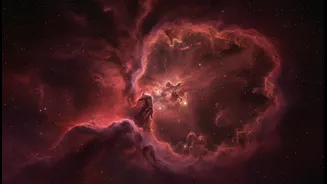
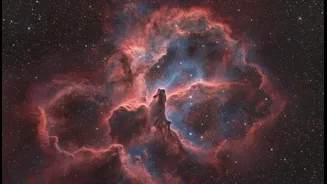
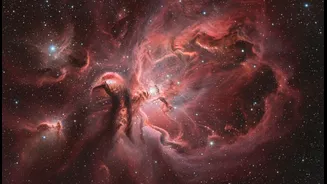
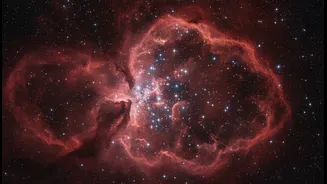
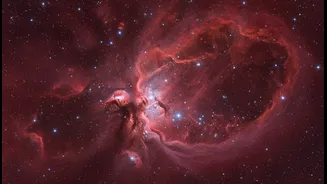
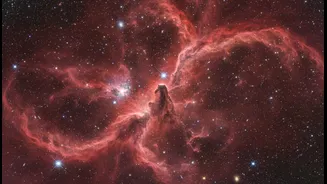
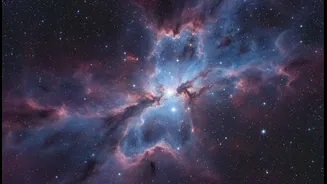
The subject of all this buzz is a vast stellar nursery known as LH 95. While not an official name, 'Crimson Cloud' is the perfect description for this spectacular region. Located in the Large Magellanic Cloud, a dwarf galaxy that orbits our own Milky
Way, LH 95 is a bustling metropolis of star formation. Like fresh fireworks scattered against dissipating smoke, brilliant blue and white stars are set against a backdrop of glowing red gas and dust. This region is one of many stellar associations in the neighboring galaxy, giving astronomers a relatively clear and close-up view of the chaotic and beautiful process of stellar birth.
The Science Behind the Crimson Glow
So, why the stunning red color? The nebula’s brilliant crimson glow is no cosmic accident; it's a specific chemical signature. It comes from something called hydrogen-alpha emissions. This type of light is a tell-tale sign that new stars are actively forming. The most massive and powerful young stars in the region, some with at least three times the mass of our Sun, unleash intense ultraviolet radiation and powerful stellar winds. This energy heats the surrounding hydrogen gas, causing it to glow brightly in this characteristic red hue. The colors in these images are more than just pretty; they are data, allowing scientists to map out the chemical composition and physical processes happening thousands of light-years away.
Thousands of Baby Stars
Hubble’s detailed observations of LH 95 have revealed an extraordinary population of around 2,500 developing stars. Many of these are considered 'pre-main-sequence stars'—infant stars that have gathered most of their mass from surrounding disks of gas and dust but have not yet ignited nuclear fusion in their cores. Essentially, they are stars that are still growing. Studying this massive population has given astronomers fresh insights into stellar evolution. The observations confirmed that as young stars age, the rate at which they pull in material slows down, but also showed that this growth process can last for several million years, longer than some previous theories suggested.
Hubble's Enduring Conversation with the Cosmos
In an era where newer instruments like the James Webb Space Telescope often grab the headlines, images like this are a powerful reminder of the Hubble Space Telescope’s enduring importance. For over three decades, Hubble has been a transformative force in our understanding of the universe. While Webb excels in the infrared, Hubble's capabilities in visible and ultraviolet light provide a unique and complementary view of the cosmos. Regions like the Tarantula Nebula and the Carina Nebula have been frequent targets for Hubble, with each observation adding new layers to our knowledge. Think of Hubble as the wise elder in the 'group chat' of telescopes—its long-term observations provide the historical context needed to make sense of new discoveries.