


A Cosmic Chemical Soup
Imagine looking up at the night sky and knowing that the same basic molecules that make up life on Earth are being cooked up in distant, alien star systems. That’s the reality scientists are now confronting. Recent observations using powerful instruments
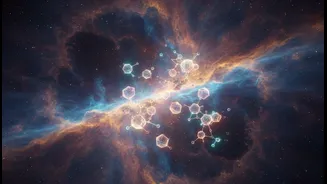
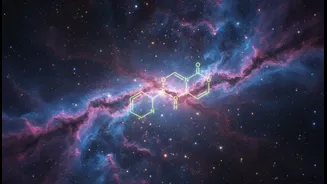
like the James Webb Space Telescope (JWST) have detected a rich inventory of complex organic molecules (COMs) in unexpected places. For the first time, compounds like ethanol, acetic acid (the stuff in vinegar), and even sugars have been identified in the icy clouds of gas and dust that surround young, developing stars, some located far outside our own Milky Way galaxy. One landmark discovery found these molecules frozen in ice around a young star called ST6 in the Large Magellanic Cloud, a neighbouring galaxy 160,000 light-years away. This suggests the recipe for life isn't a local secret; it's being shared across galaxies.
Not Life, But a Recipe Book
It is crucial to understand what these discoveries mean, and what they don’t. Scientists have not found alien life. What they have found are the prebiotic molecules that are the precursors to life as we know it. Think of it as finding a well-stocked kitchen with flour, sugar, and eggs, but no finished cake. These organic molecules are the raw materials—compounds like methanol, acetaldehyde, and even precursors to amino acids and the sugars needed for RNA. The presence of these molecules shows that the chemical processes that could eventually lead to life are happening in environments vastly different from early Earth. This discovery implies that the universe is seeded with these essential ingredients, waiting for the right conditions—like a planet in the 'habitable zone'—to potentially assemble into something more.
How Are These Ingredients Made?
These life-starting ingredients form on the surfaces of tiny, freezing dust grains floating in interstellar clouds. Atoms like carbon, hydrogen, and oxygen drift through space and stick to these icy grains, where the cold, stable environment allows them to combine into more complex structures over millions of years. These clouds of gas and dust are the very same nurseries where stars and planets are born. Later, during the chaotic formation of a planetary system, these organic-rich dust grains and ices can be incorporated into asteroids and comets. These celestial bodies then act like cosmic delivery trucks, crashing into young planets and depositing their precious cargo of water and organic molecules. This is how many scientists believe Earth got its initial supply of the materials needed to spark life.
Why This Changes Everything
For decades, a central question in astrobiology has been whether the chemistry that led to life on Earth was a rare fluke or a common cosmic process. These new findings strongly support the latter. By detecting these molecules in a galaxy like the Large Magellanic Cloud, which has a different chemical composition and harsher radiation environment than the Milky Way, scientists have shown that the building blocks of life are incredibly resilient and can form under a wide variety of conditions. It suggests that the potential for habitable worlds is not just a feature of our own galaxy, but could be a universal constant. The chemical starting line for life may exist on countless worlds across the cosmos, dramatically increasing the odds that we are not alone.