


A Glimpse into the Cosmic Dawn
Imagine looking so far away that you're actually looking back in time. That's what astronomers have done, using the powerful JWST and the Gemini North telescope in Hawai'i. They've spotted a system, officially named J1602+4228AB, as it appeared just 900
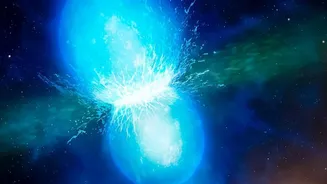
million years after the Big Bang. This era is known as 'cosmic dawn', a time when the very first stars and galaxies were igniting. At the heart of this discovery are two quasars—incredibly bright objects powered by supermassive black holes—separated by about 18,100 light-years. While that sounds vast, it's actually about one-fifth the diameter of our own Milky Way galaxy, making them an unusually close pair for that early epoch.
What Exactly Is a Quasar?
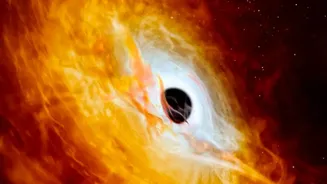
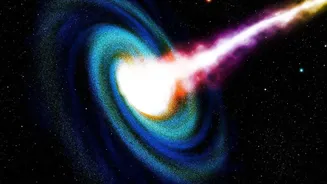
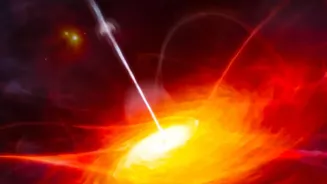
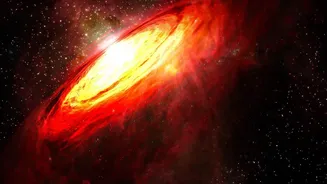
Think of a quasar not as a star, but as a cosmic lighthouse. The term is short for 'quasi-stellar object'. At the center of some galaxies lies a supermassive black hole, an object with gravity so strong that nothing, not even light, can escape. When this black hole is actively 'feeding' on surrounding gas and dust, the material swirls into an accretion disk around it. The immense friction and gravitational forces heat this disk to millions of degrees, causing it to shine with an unimaginable brilliance—often outshining all the billions of stars in its host galaxy combined. This intense glow is what we see as a quasar, a beacon that allows us to spot galaxies from billions of light-years away.
Meet the Ancient Power Couple
The discovered pair, given the Hawaiian nickname Nāpōwawāʻenakaulua, is truly exceptional. One of the black holes powering these quasars is estimated to have a mass of 1.5 billion times that of our sun, while its companion weighs in at a still-staggering 400 million solar masses. Finding even one such massive black hole so early in the universe's history is a puzzle for astronomers. Finding two of them so close together challenges current theories about how quickly these cosmic giants can form. The name Nāpōwawāʻenakaulua evokes 'two celestial bodies of fathomless powerful darkness in the brilliance of heat', a fitting description for these behemoths.
Why This Discovery Is a Big Deal
Finding a pair of quasars is a tell-tale sign of a galaxy merger in progress. Scientists believe that galaxies grow by colliding and merging, and when this happens, the supermassive black holes at their centers are drawn closer together. Such cosmic collisions provide a feast of gas and dust, which can ignite both black holes, turning them into a quasar pair. This discovery confirms that such massive mergers were happening very early in cosmic history, providing a real-world laboratory for studying how the first huge galaxies were assembled. However, the sheer size of these black holes so soon after the Big Bang is something current models can't fully explain, suggesting there may be more to learn about black hole growth.
The Power of Webb
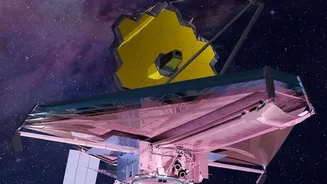
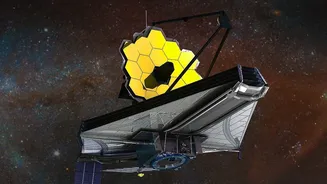
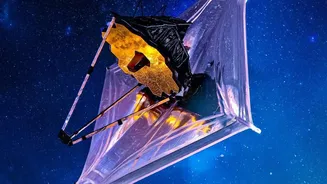
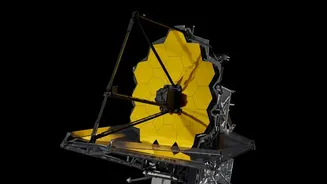
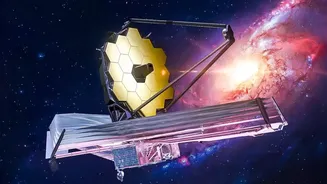
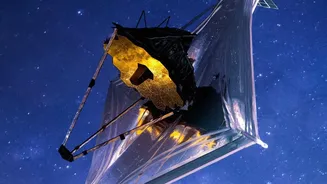
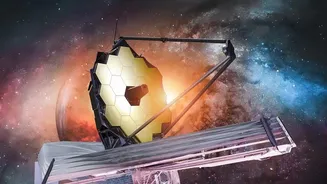
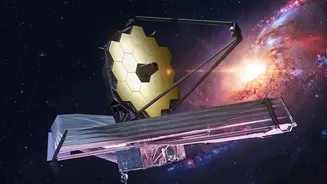
Discoveries like this are precisely why the James Webb Space Telescope was built. Its incredible sensitivity to infrared light allows it to peer deeper into the distant, early universe than ever before. The Nāpōwawāʻenakaulua system was first identified as part of the Aether survey, a JWST program to create a census of early universe objects. While inspecting the data, astronomers noticed a faint companion next to a known quasar. Follow-up observations were crucial; the team used both Webb and the Gemini North telescope to confirm that they were seeing two distinct quasars and not a single object distorted by a gravitational lens. This powerful combination of space and ground-based telescopes makes it possible to resolve these faint, distant systems and unlock their secrets.