


Seeing the Universe's Oldest Light
To understand why infrared astronomy is such a game-changer, we need to think about how we see the past. Because light takes time to travel across the vastness of space, looking at distant objects is literally looking back in time. The light from the most
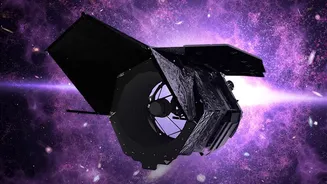
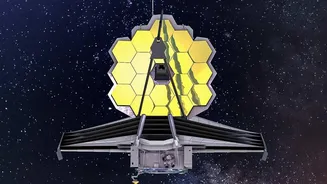
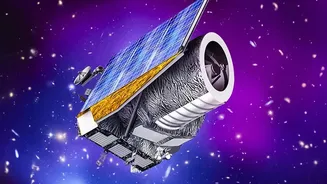
distant galaxies visible today has been travelling for over 13 billion years. But there's a cosmic twist. Since the Big Bang, the universe has been expanding, and this expansion stretches the light waves travelling through it. Light that was originally emitted as visible or ultraviolet light from the first stars and galaxies gets stretched into longer, redder wavelengths. This phenomenon is called 'redshift'. For the most ancient objects, this light is stretched so much that by the time it reaches us, it falls into the infrared part of the spectrum, which is invisible to the human eye and to telescopes like Hubble that primarily see visible light. Instruments like the James Webb Space Telescope (JWST) were specifically designed to capture this faint, ancient infrared glow, allowing us to see an era of the cosmos that was previously hidden.
Staring into the Cosmic Dawn
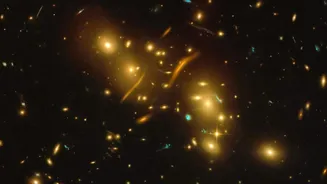
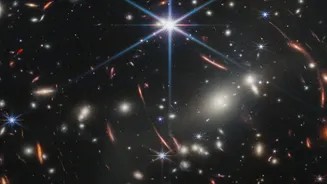
The other key part of the puzzle is the 'deep field' survey. Imagine pointing a camera at what seems to be a dark, empty patch of sky. Now, leave the shutter open for hundreds of hours, collecting every single photon that trickles in. This is the basic principle of a deep field. Instead of a blank picture, you get an image filled with thousands of tiny smudges, each one a distant galaxy. This technique allows astronomers to probe the 'Cosmic Dawn', the period just a few hundred million years after the Big Bang when the first stars and galaxies ignited, ending the cosmic dark ages. By combining deep field methods with infrared sensitivity, telescopes like JWST are essentially conducting an archaeological dig of the early universe, uncovering the very first structures to take shape. This allows scientists not just to theorize about how galaxies formed, but to actually see them in their infancy.
Galaxies That Are Too Big, Too Soon
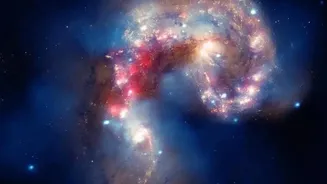
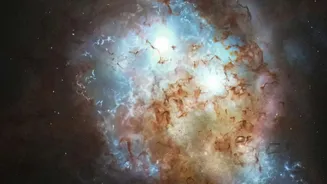
For decades, the standard model of cosmology predicted a slow, methodical process for galaxy formation. Tiny fluctuations in the density of the early universe would gradually pull in gas, forming small protogalaxies that would then merge and grow over billions of years into the grand spirals and ellipticals we see today. But infrared deep field surveys are showing this story might be wrong. JWST is consistently finding galaxies in the early universe that are shockingly massive, bright, and well-structured. Some discoveries show complex mergers of multiple galaxies happening far earlier than models predicted. Astronomers have found galaxies that are hundreds of times more numerous than expected, as well as huge protoclusters beginning to form only a billion years after the Big Bang, a process that was thought to take much longer. Even more puzzling, some of these ancient galaxies appear 'dead', meaning they have already stopped forming stars, a sign of maturity that scientists thought took billions of years to reach. It's been compared to finding a two-year-old child who looks and acts like a teenager.
Rewriting the Cosmic Playbook
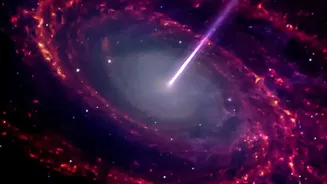
These discoveries are forcing a major revision of astrophysical models. The existence of such mature galaxies so early on suggests that the processes of star formation and galaxy assembly were far more rapid and efficient than previously thought. The old 'bottom-up' model of slow, gradual growth is being challenged by evidence that suggests a 'top-down' scenario might also be at play, where massive structures could form much more quickly. Scientists are now exploring new theories to explain this rapid development. Perhaps the first stars were far more massive than today's, burning through their fuel and seeding the cosmos with heavy elements at an accelerated rate. Another possibility involves the role of supermassive black holes. Instead of forming after a galaxy, some theories propose that massive black holes could have formed first, acting as gravitational seeds that rapidly pulled in enormous amounts of gas to kickstart galaxy formation at an incredible pace. Strange objects, like potential 'black hole stars', are also being investigated as part of this new cosmic puzzle.