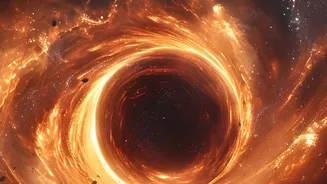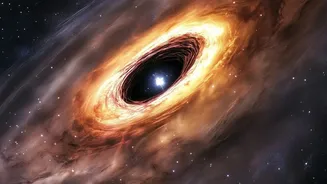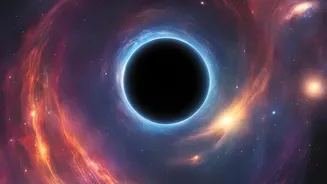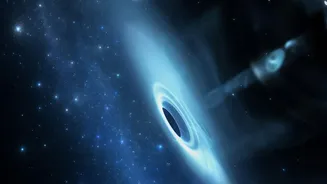




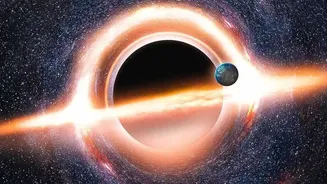
Black holes are famous for pulling things in, not breaking apart. We see them merge, but could the reverse happen? New theoretical research challenges a core cosmic rule, suggesting that under extreme conditions, one black hole might split in two.
The Cosmic Rule of No Return
For
decades, the physics of black holes seemed straightforward in one regard: they grow, they merge, but they do not divide. When two black holes collide, they form a single, larger one, sending gravitational waves rippling across the universe. This one-way street is governed by fundamental principles, particularly the laws of thermodynamics. A key concept is entropy, a measure of disorder in a system. According to established physics, a non-rotating black hole splitting into two smaller ones would cause a decrease in total entropy. This is a process that is considered 'thermodynamically unfavorable', which is a physicist's way of saying it just shouldn't happen. This principle, known as Hawking's area theorem, has been a cornerstone of black hole physics, suggesting that the total surface area of black hole event horizons can never decrease.
A Loophole in the Laws of Physics
A recent theoretical study, however, has identified a potential loophole. A team of researchers from Italy, France, and Denmark investigated what might happen if a black hole spins at an exceptionally high speed. Their work, published in the journal Physical Review D, proposes that extreme rotation could change the thermodynamic rules. The calculations suggest that for a black hole rotating at or very near its maximum possible speed, a split might not violate the law of entropy. This rapid spin injects a huge amount of rotational energy into the system, potentially creating a scenario where splitting becomes a possibility without breaking fundamental physical laws.
The 'Pair-of-Pants' Problem
Even if a split is thermodynamically allowed, there is another major hurdle: the two newly formed black holes would have to escape each other's immense gravity. Otherwise, they would immediately fall back together and merge again. The researchers found that this requirement narrows the possibility of a split almost completely, leaving only a tiny window open for black holes spinning at their absolute maximum rate. The study's unusual title, 'When Black Holes Admit Pair-of-pants Topologies', describes the shape the event horizon would make in spacetime during such a split—a single tube dividing into two separate 'legs'. This visual captures the immense challenge of not only initiating the split but ensuring the two resulting black holes can go their separate ways.
Beyond Einstein and into the Primordial Past
The probability of this actually happening is still unknown and depends on aspects of gravity that go beyond Einstein's well-tested theory of general relativity. The researchers are now working to quantify these probabilities. According to coauthor Francesco Sannino, smaller, primordial black holes—hypothetical black holes that may have formed shortly after the Big Bang—are more likely candidates for splitting than the large astrophysical black holes we currently observe. The team also explored more exotic theories involving extra dimensions of space, where similar blackholelike objects could become unstable and break apart, especially if one of the resulting fragments is much smaller than the other.
Searching for the Unseen
While there is no confirmed observation of a black hole splitting, the research opens up an exciting new avenue for astronomers. The scientists suggest that such an event might be detectable, though not directly. If a split were to occur, particularly involving smaller primordial black holes, it could release signals in the form of highenergy light. Gammaray telescopes, such as the FermiLAT space telescope, could potentially search for these faint signals from tiny black hole fragments. Detecting such a signal would be revolutionary, providing the first evidence for physics beyond Einsteins theories and confirming that even the most destructive objects in the universe might have a creative, or at least a divisive, side.