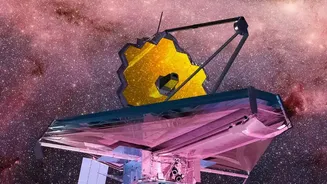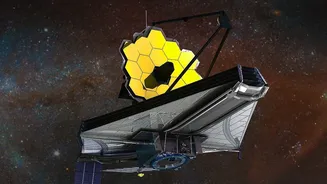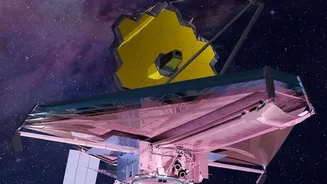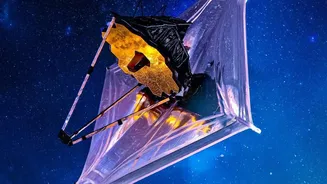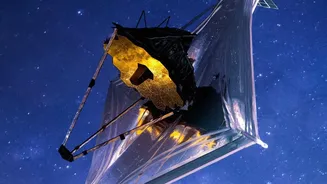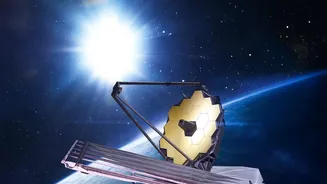




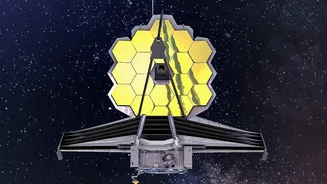
The James Webb Space Telescope (JWST) constantly delivers stunning images and data from the dawn of time. A recent discovery of an ancient quasar pair is rewriting cosmic history, but JWST didn't do it alone. Here's what it found and why another telescope
was essential.
Cosmic Beacons at the Edge of Time
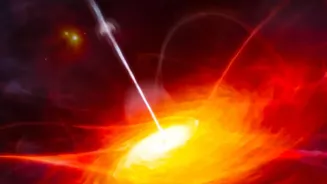
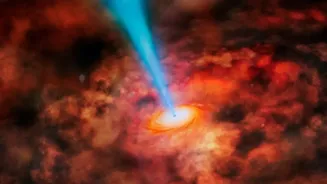
First, what exactly is a quasar? The name is short for 'quasi-stellar radio source'. They are not stars, but the intensely bright cores of distant galaxies. At the center of these galaxies are supermassive black holes, billions of times the mass of our sun, that are actively feeding on enormous amounts of gas and dust. As this material spirals into the black hole, it heats up to incredible temperatures, releasing an astonishing amount of energy that can outshine the entire host galaxy. Because they are so luminous, quasars act as cosmic beacons, allowing astronomers to study the universe when it was very young. Observing them is like looking back in time to the 'cosmic dawn', just after the first stars and galaxies formed.
Webb Spots Something 'Impossible'
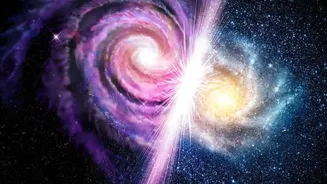
The James Webb Space Telescope, during a survey of the early universe called the Aether survey, spotted something puzzling just 900 million years after the Big Bang. It was an object designated J1602+4228A, a quasar from the cosmic dawn. Upon visual inspection, astronomers noticed it seemed to have a faint companion. The discovery of a pair of quasars this early in the universe's history is a major challenge to existing theories. Scientists believe supermassive black holes need at least a billion years to grow to such immense sizes. Finding one so ancient is remarkable; finding a pair so close together—separated by only 18,100 light-years—is theoretically baffling. The system, nicknamed Nāpōwawāʻenakaulua, presents a problem: current models cannot definitively explain how these giants grew so big, so fast, so early.
The Need for a Second Opinion
While JWST is unparalleled in its sensitivity and ability to peer deep into space, it had a crucial limitation in this case. From its vantage point, it saw two points of light very close together. But it couldn't definitively prove they were two separate quasars. An alternative explanation was a phenomenon called gravitational lensing, where a single, massive object in the foreground bends the light from a more distant object, creating a double image. To rule this out and confirm they were a true binary pair, astronomers needed a different kind of observation—a detailed analysis of the light from each source individually, known2 as spectroscopy. This is where a powerful ground-based telescope came into play.
Gemini North Steps In
To get the necessary data, the team turned to the Gemini North telescope in Hawai'i. Located on the dormant volcano Maunakea, Gemini North benefits from the dry, stable air above it, providing exceptionally clear views. Using its Near-Infrared Spectrograph (GNIRS), the telescope could perform the detailed spectroscopic analysis needed. This instrument separates the light from an object into its constituent wavelengths, much like a prism makes a rainbow. These 'spectra' contain fingerprints of the chemical elements and physical conditions of the source. By capturing separate spectra for each of the two light sources, astronomers could compare them. The observations were so successful, thanks to pristine weather conditions, that the team collected all the data they needed in just two nights.
Two Telescopes, One Astonishing Story
The Gemini North data was the key that unlocked the mystery. The spectra of the two objects were different, which strongly favored the conclusion that they were two separate quasars and not a lensed image of one. With this confirmation, JWST's initial sighting was validated as the oldest and most compact quasar pair ever discovered. The combined observations allowed scientists to estimate the masses of the two supermassive black holes at a staggering 1.5 billion and 400 million times the mass of the Sun. The discovery showcases the powerful synergy between space-based and ground-based observatories. JWST has the sheer power to find these faint, distant objects, while advanced ground telescopes like Gemini provide the specialized analysis needed to interpret what is being seen.
Rewriting the Story of the Universe
The confirmation of Nāpōwawāʻenakaulua as a true quasar pair so early in cosmic history has profound implications. It suggests that the processes that build galaxies and grow supermassive black holes were happening much faster and more furiously than previously thought. The system is likely located in an exceptionally dense region of the early universe, where galaxy interactions were frequent, providing ample fuel for both intense star formation and the rapid growth of black holes. This unique finding serves as a natural laboratory for studying how the very first massive galaxies and their central black holes assembled, providing a crucial clue in the ongoing quest to understand our cosmic origins.