





A New Window on Cosmic Nurseries
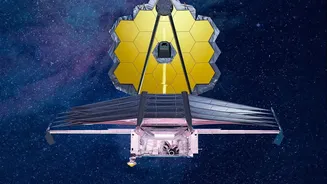
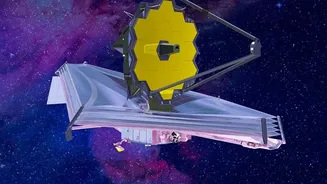
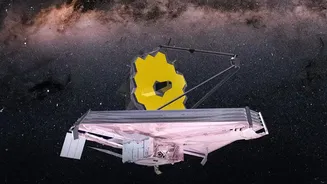
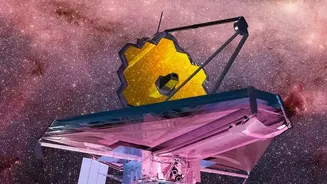
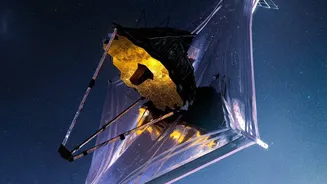
The James Webb Space Telescope is the most powerful space observatory ever built, and its magic lies in its ability to see the universe in infrared light. This is crucial because the places where stars and planets form are shrouded in thick clouds of
gas and dust. Visible light telescopes can't see inside these cosmic nurseries, but infrared light can pass through the dust, much like X-rays let doctors see inside the human body. This capability allows the JWST to peer into the heart of protoplanetary disks—vast, spinning rings of gas and dust that surround young stars and provide the raw materials for planet formation. Before Webb, we had glimpses of these regions, but we couldn't make out the fine details of their chemical makeup. Now, armed with instruments like the Mid-InfraRed Instrument (MIRI), astronomers can dissect the light coming from these disks and uncover the secrets hidden within.
Water in the Rocky Planet Zone
One of the most exciting recent discoveries comes from a young star system called PDS 70, located 370 light-years away. Using the JWST, astronomers detected the unmistakable signature of water vapour in the inner part of this star's protoplanetary disk. This is the first time water has been found in the terrestrial, rocky-planet-forming region of a disk that is already known to host at least two giant planets further out. The water was found less than 160 million kilometres from the star, a distance comparable to Earth's orbit around our Sun. This discovery is significant because it was made in a relatively old disk, around 5.4 million years old, where astronomers previously suspected that intense stellar radiation would have destroyed any nearby water. The finding suggests that rocky planets forming in this zone could have access to water from the very beginning of their creation, a crucial ingredient for habitability.
Decoding the Water Vapour 'Spectra'
The headline's mention of "spectra" is the key to understanding the breakthrough. A spectrum is essentially a chemical fingerprint. When starlight passes through a gas, like water vapour, the molecules absorb very specific colours, or wavelengths, of that light. The JWST’s instruments capture the light that makes it through, and the missing slivers create a unique barcode-like pattern—a spectrum. This pattern doesn't just tell scientists that water is present; it reveals much more. From the details of the spectral lines, researchers can determine the water's temperature, its density, and even its motion. For example, the water detected in the PDS 70 disk is not liquid but a hot vapour, blazing at around 330 degrees Celsius. This level of detail was impossible to achieve before Webb and is transforming our ability to perform chemistry on a cosmic scale.
Building Blocks of Future Earths
So, why does finding hot water vapour in a dusty disk matter so much? It directly addresses one of the biggest questions in planetary science: how did Earth get its water? One theory is that it was delivered late in our planet's formation by icy comets and asteroids. However, discoveries like the one in PDS 70 suggest another possibility: that water is present as a vapour in the inner disk and can be incorporated into rocky planets as they form. This means that planets like Earth might not need a special delivery of water; they could be born with this essential ingredient already baked in. By studying the distribution and state of water in these young systems, scientists can refine their models of planet formation and better understand the pathway from a simple gas cloud to a potentially habitable world teeming with oceans. The detection of water vapour implies that if rocky planets are forming in PDS 70, they have the necessary materials for life as we know it from the start.