





A Celestial Game of Hide-and-Seek
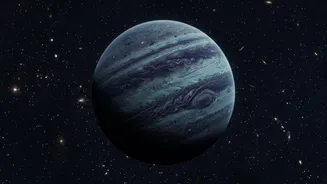
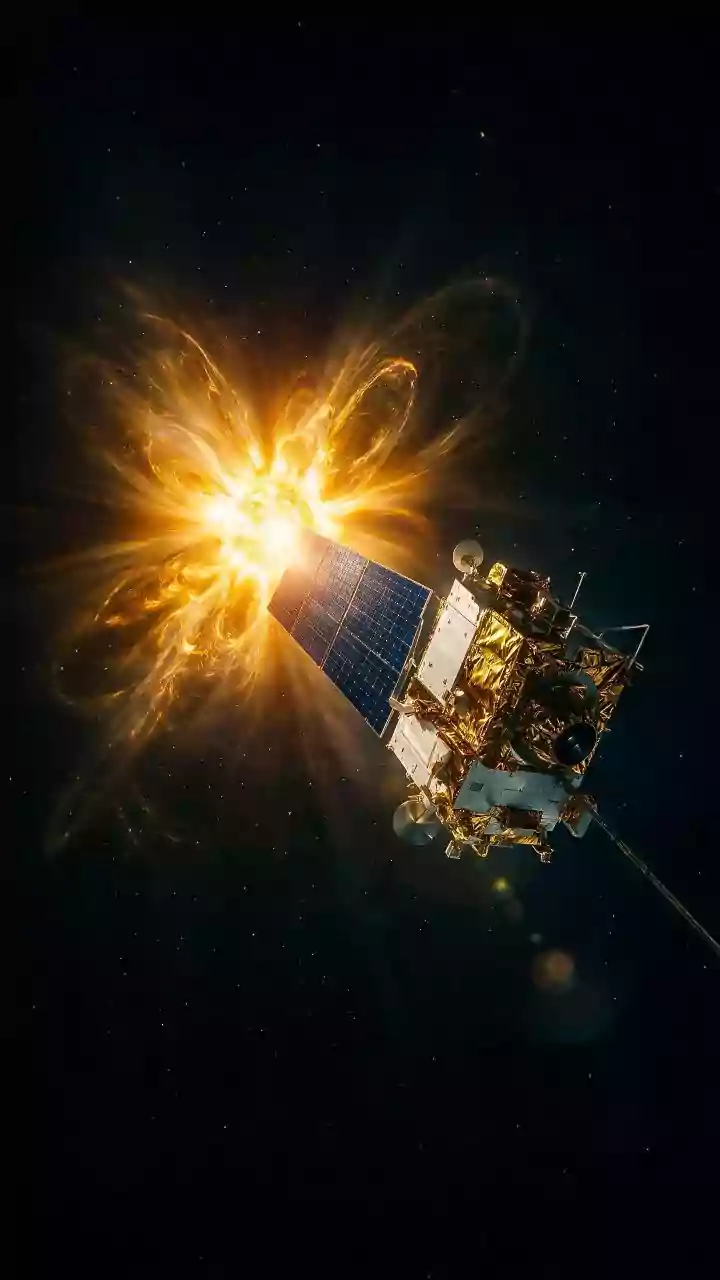
For seven years, from 2019 to early 2026, NASA's Transiting Exoplanet Survey Satellite (TESS) faithfully watched TOI-2535 b. This world, a type known as a 'hot Jupiter', is a gas giant similar in size to our own Jupiter but orbits its star in a blistering
8.25 days. TESS detects planets using the transit method, watching for the tiny, regular dip in a star's brightness when a planet passes in front of it from our perspective. But in March 2026, the dips from TOI-2535 b stopped. The planet, which astronomers had been carefully observing, simply wasn't transiting anymore. It was as if it had played a cosmic game of peekaboo and decided to hide.
The Clues in the Wobble
Of course, planets do not just vanish. Before it disappeared, TOI-2535 b was already behaving strangely. Its transits were not happening on a clockwork schedule; sometimes the planet would arrive up to six hours early, other times six hours late. This phenomenon, called transit timing variation (TTV), is a telltale sign that another object's gravity is pulling on the planet. Furthermore, the transits themselves were changing, becoming shorter and shallower over the years. This indicated that the planet's path was moving across the face of its star, eventually shifting off the edge entirely. The gravitational culprit is an unseen neighbouring planet, believed to be at least the mass of Saturn.
An Extreme Orbital Dance
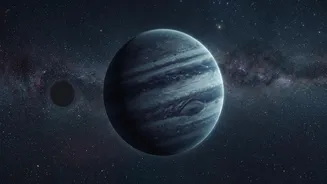
This unseen companion is what makes the TOI-2535 system so remarkable. The two massive planets are locked in a gravitational dance that causes their orbits to precess, or wobble, like spinning tops. Their orbits are not on the same flat plane but are tilted relative to each other by at least five degrees. This mutual inclination, combined with their strong gravitational interaction, is causing the rapid change in TOI-2535 b's orbit—the fastest such change ever observed for a planet around a single star. According to researchers at UCLA who led the study, it is this extreme wobble that tilted TOI-2535 b's orbit just enough to move it out of our line of sight.
Rewriting the Rules of Planet Formation
This discovery does more than just solve a celestial mystery; it challenges our understanding of how planetary systems form. Hot Jupiters are typically found alone, as their inward migration is thought to be a violent process that would eject any nearby worlds. However, the presence of a massive, nearby companion in the TOI-2535 system suggests a different origin story. It points to a more peaceful, gradual migration where the planets spiralled inward together within their protoplanetary disk. This represents a rare formation channel that scientists are eager to study further. Finding two giant planets so close together in a resonant, tilted dance provides a unique laboratory for testing theories of planetary evolution.