




More Than Just Pretty Pictures
When the Artemis II crew returned to Earth in April 2026, they brought with them over 800 gigabytes of data, including thousands of high-resolution photographs and videos. But these are not your typical holiday snapshots. Captured using a combination
of professional-grade Nikon cameras and specialised external vehicle cameras, this imagery provides a multi-layered view of the lunar surface. The cameras on the Orion spacecraft were designed to gather scientific intelligence, revealing details about the Moon’s geology and mineral composition. For scientists, these images are crucial data points that help prepare for future missions, including the planned landings at the lunar south pole.
A New Perspective on the Moon
For the first time in over half a century, human eyes and advanced digital cameras worked in tandem to document our celestial neighbour. The crew, consisting of Commander Reid Wiseman, Pilot Victor Glover, and Mission Specialists Christina Koch and Jeremy Hansen, provided real-time observations that add irreplaceable context to the digital files. This combination of human annotation and high-fidelity imaging is a game-changer. Researchers can now compare the crew's descriptions of colour and texture with data from robotic probes like the Lunar Reconnaissance Orbiter, refining our understanding of how human perception aligns with instrument readings—a vital step for when astronauts perform science on the surface.
Unlocking the Secrets of the South Pole
A key focus for Artemis II was observing the lunar south pole, a region believed to be rich in water ice and ancient rock. The crew paid special attention to the 'terminator'—the line between lunar day and night. The low-angle sunlight along this line casts long, dramatic shadows that reveal the rugged terrain in sharp detail, mimicking the lighting conditions future landing crews will face. These observations are critical for identifying safe and scientifically interesting landing sites for Artemis III and beyond, where resources like water ice could one day be used for fuel and life support.
Witnessing a Dynamic Moon
One of the most surprising findings came from the astronauts' own eyes. During their flyby, the crew witnessed and documented at least five distinct flashes on the Moon's darkened surface. After careful analysis, NASA's science team confirmed these were not camera glitches or reflections but actual meteorite impacts. While Apollo astronauts had reported similar phenomena, the ideal viewing conditions during a total solar eclipse allowed the Artemis II crew to spot some of the faintest impacts ever seen by the unaided eye. This provides valuable data on the frequency of small impacts, a key safety consideration for a future lunar base.
Building on the Legacy of Apollo
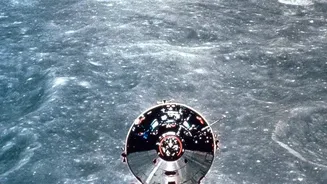
The Artemis II mission was in many ways a spiritual successor to Apollo 8, which first carried humans around the Moon in 1968. However, the technology has advanced light-years. The new images offer unprecedented detail of the far side of the Moon and a clearer understanding of its geological history. They show subtle colour variations, like yellowish hues on the Aristarchus Plateau, which can indicate different mineral compositions and a complex volcanic past. This leap in data quality allows scientists to build upon the foundational knowledge from the Apollo era, asking more complex questions and planning more ambitious explorations.