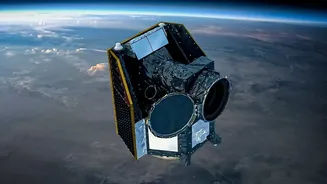








For over 35 years, the Hubble Space Telescope has been humanity's eye on the cosmos. But its legendary journey is nearing an end as its orbit decays. In a major policy shift, NASA is now asking the private sector for a rescue plan.
A Ticking Clock in Orbit
Like all satellites
in low-Earth orbit, the Hubble Space Telescope is in a constant battle with gravity and atmospheric drag. Though the atmosphere is incredibly thin hundreds of kilometres up, it still exerts a tiny pull, causing the telescope's orbit to slowly shrink. Without its own propulsion system, Hubble has relied on periodic boosts to stay aloft, the last of which occurred during a Space Shuttle mission in 2009. Since then, its altitude has been steadily decreasing. Current projections estimate its uncontrolled reentry could happen between 2033 and 2034, with the exact timing dependent on solar activity which can cause the atmosphere to expand and increase drag. This has created a sense of urgency, prompting NASA to set a target of 2032 for any potential intervention.
Why NASA Needs Outside Help
In the past, servicing Hubble was the exclusive domain of NASA's Space Shuttle program. Astronauts conducted five complex missions to repair and upgrade the telescope, significantly extending its life. However, with the shuttle's retirement in 2011, NASA lost its only vehicle capable of performing such a hands-on service mission. Facing this capability gap and budget constraints, the agency is now turning to a rapidly evolving commercial space sector. This pivot represents a significant change in strategy, moving from a government-led approach to a public-private partnership model for maintaining critical space assets. NASA Administrator Jared Isaacman stated it is the agency's duty to the taxpayer and scientific community to explore innovative and cost-effective ways to extend the life of an on-orbit asset like Hubble.
A Call for Ideas, Not a Contract
In late October 2026, NASA issued a formal 'Request for Information' (RFI). This isn't a contract for a mission but rather a form of market research to gauge what is technically and financially possible. The agency has laid out three potential paths for commercial partners to consider. The first and most hopeful option is to 'reboost' Hubble to a higher, more stable orbit of at least 600 kilometres, which could add another 15 to 25 years to its operational life. The second option involves servicing the telescope to enhance its performance. The final, more pragmatic option is a controlled de-orbit, where a vehicle would guide Hubble to a safe splashdown in a remote part of the ocean, preventing an uncontrolled crash. Companies have until November 30, 2026, to submit their concepts.
Who Could Answer the Call?
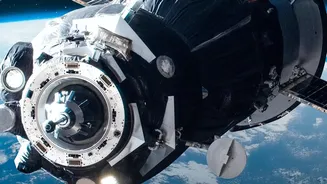
This isn't the first time a commercial rescue has been discussed. In 2022, NASA and SpaceX signed an agreement to study the feasibility of using a Dragon spacecraft for a reboost mission, a study funded by the Polaris Program led by billionaire Jared Isaacman. While that study determined a mission was technically possible, it did not result in a funded plan. The new RFI opens the door to a wider range of companies that have been developing in-space servicing and logistics capabilities. A mission could be robotic, using a specially designed 'space tug' to dock with and push the telescope, or it could involve a crewed mission, as the RFI allows for concepts that include astronauts. The chosen company would be responsible for providing the launch vehicle, the spacecraft, and all mission operations.
More Than Just One Telescope
The fate of Hubble is a test case for the future of space operations. A successful commercial mission would set a precedent for servicing other valuable satellites, both governmental and private, that were never designed to be repaired in orbit. It could also pioneer new methods for managing orbital debris by safely removing defunct satellites before they become a hazard. While Hubble's scientific contributions in visible and ultraviolet light are unique and not fully replicated by the newer James Webb Space Telescope, its potential rescue is also about building a sustainable commercial ecosystem in low-'Earth orbit. Nicky Fox, NASA's associate administrator for science, noted that the commercial industry has evolved rapidly, and the agency is eager to explore the possibilities.