





A Glimpse of a New World
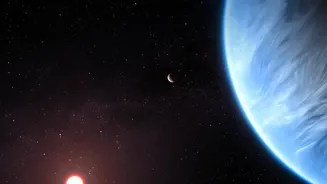
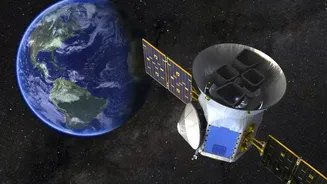
In April 2019, NASA's Transiting Exoplanet Survey Satellite (TESS) detected a faint, periodic dimming of a star roughly 1,000 light-years from Earth. This is the tell-tale sign of a transiting exoplanet: a world passing in front of its star from our point
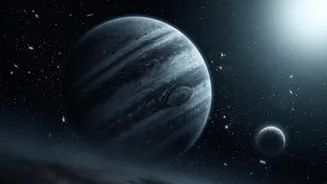
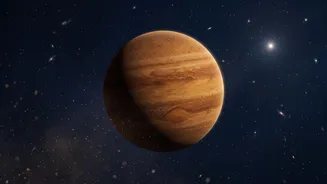
of view, causing a mini-eclipse. Astronomers were excited. The data pointed to a 'hot Jupiter', a gas giant similar in size to our own Jupiter but orbiting its star in a blisteringly fast 8.25 days. Dubbed TOI-2535 b, it joined the growing catalogue of over 8,000 candidate exoplanets identified by TESS. The initial observations were routine, and scientists prepared for follow-up studies to confirm its existence and learn more about its properties.
The Case of the Vanishing Planet
When astronomers pointed other telescopes at the TOI-2535 system to catch the planet's next pass, they found nothing. The expected dimming of starlight didn't happen on schedule. For a while, this wasn't alarming; planets can have irregular schedules. But as months turned into years, TOI-2535 b remained stubbornly invisible. By early 2026, the planet had officially stopped transiting its star. Planets don't just vaporise, so where did it go? It became a cosmic missing person's case. The once-promising candidate was now a genuine puzzle, challenging our understanding of planetary dynamics.
A Wobble in the System
The key to solving the mystery lay in the early data. A re-examination of the original transits from 2019 onwards showed that TOI-2535 b was never on a perfectly regular schedule. Its arrivals were erratic, sometimes showing up as much as six hours early or late. This phenomenon, known as Transit Timing Variation (TTV), is a huge clue. It meant something massive was gravitationally tugging on the planet, disrupting its orbit. The data also showed that with each observed transit, the path became shorter and shallower, suggesting its orbit was tilting away from our line of sight. This led to a compelling hypothesis: an unseen companion planet was pulling TOI-2535 b's orbit out of alignment.
The Unseen Neighbour
The breakthrough came from a detailed analysis of all observations made between 2019 and 2026. A team led by astronomers at UCLA confirmed that TOI-2535 b was not gone, but merely hidden. Its orbit is being influenced by another massive, unseen planet in the same system, now catalogued as TOI-2535 c. The powerful gravitational pull between these two giants causes their orbits to wobble like spinning tops. Over seven years, this wobble tilted TOI-2535 b's orbit just enough that, from our perspective, it no longer crosses the face of its star. The planet is still there, faithfully circling its sun, but it's now passing above or below the star from our viewpoint.
What This Means for Planet Hunting
The confirmation of the first 'disappearing' transiting exoplanet is a landmark discovery. It's the most extreme example of planetary interaction ever observed, with an orbit tilting so quickly that it vanished while we were watching. It proves that planetary systems can be far more dynamic and less clockwork-like than previously thought. This discovery highlights the importance of long-term observation, as the seven-year baseline of data was crucial to solving the puzzle. While we won't see TOI-2535 b transit again for another 30 to 50 years, astronomers predict its hidden neighbour, TOI-2535 c, may wobble into a transiting configuration much sooner, giving us a chance to finally see the world that caused all the commotion.