






The Old NASA Way
Traditionally, a mission to Mars was an epic undertaking shouldered almost entirely by NASA. From designing and building the rocket to manufacturing the sensitive scientific instruments and managing the complex, months-long journey through space, the agency
did it all. This model produced incredible successes, from the Viking landers to the Perseverance rover. However, it is also incredibly expensive and time-consuming. Each mission required years of planning and billions in taxpayer dollars, meaning the cadence of missions was slow. A single failure could set back scientific objectives by a decade. This all-in, go-it-alone approach, while historically necessary, was becoming a bottleneck for humanity's ambitions in deep space.
A New Martian Playbook
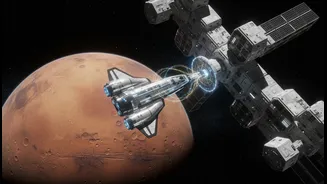
Recognizing the need for a more agile and sustainable approach, NASA is embracing public-private partnerships (PPPs) for its Mars exploration goals. This model is a strategic shift, moving NASA from being the sole builder and operator to a role of an anchor customer and scientific lead. The idea is simple but revolutionary: NASA defines the scientific objectives and often builds the specialized instruments, while private companies compete to provide the transportation and operational services—the rocket, the spacecraft, and the mission management—to get that science to Mars. This is not entirely new; private companies have been resupplying the International Space Station for years. But applying this commercial delivery service model to an interplanetary destination like Mars marks a major evolution in space exploration strategy.
Sharing Risk, Sharing Reward
The core of this new model is risk-sharing. Deep-space exploration is inherently risky, both technically and financially. Under the old model, NASA and the US taxpayer bore almost all of that risk. The new approach divides the responsibilities. A company that successfully delivers a NASA payload to Mars proves its technology and deep-space capabilities, making it a strong competitor for future lucrative contracts. NASA, in turn, can dedicate its budget to developing high-value scientific instruments and data analysis, rather than the full cost of a launch vehicle. This spreads the financial burden and encourages innovation as commercial firms are incentivized to develop more efficient and cost-effective technologies to win contracts. It's a symbiotic relationship where commercial success is tied directly to advancing scientific frontiers.
The Private Pioneers
This strategic shift is already in motion. NASA recently announced a partnership with Relativity Space for a mission dubbed "Aeolus," slated for a 2028 launch. Under this six-year Space Act Agreement, NASA's Ames Research Center is developing a suite of four advanced instruments to study the Martian atmosphere. Relativity Space, meanwhile, is responsible for providing the rocket, the spacecraft, and managing the entire flight to deliver the payload. This mission will provide the first daily, global look at Martian winds and weather—critical data needed to safely land future robotic and human missions. This collaboration serves as a crucial test case, demonstrating how pairing NASA's scientific expertise with commercial innovation can accelerate the pace of discovery.
Challenges on the Horizon
While the PPP model holds immense promise, it is not without challenges. The 26-month gap between favorable launch windows to Mars presents a significant hurdle for maintaining industrial momentum, unlike the more frequent opportunities for Moon-focused missions. There are also questions about the long-term commercial viability when, for the foreseeable future, NASA remains the primary, if not sole, customer for these deep-space services. Furthermore, ensuring seamless communication and managing risk between a government agency and a commercial entity on a mission millions of miles away requires new levels of oversight and collaboration. The success of these partnerships will depend on creating a stable framework that allows commercial capabilities to grow and survive between mission opportunities.