





A Hostile and Unforgiving Environment
The lunar surface is no place for a long-term stay. Without a protective atmosphere or global magnetic field, it's constantly bombarded by galactic cosmic rays and intense solar particle events. This radiation poses a significant threat to human health.
On top of that, temperatures swing wildly from over 120°C in the day to a bone-chilling -130°C at night. Add the persistent threat of micrometeorite impacts, and it becomes clear that any sustainable human presence requires a robust shelter. Building such structures on the surface would be an immense and costly undertaking, requiring thick shielding to be transported from Earth. But what if the Moon itself has already provided the perfect real estate?
The Moon's Hidden Sanctuaries
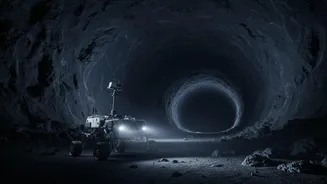
Enter lunar lava tubes. Billions of years ago, when the Moon was volcanically active, rivers of flowing lava carved out vast underground tunnels. As the lava drained away, it left behind enormous, structurally sound caverns. Some are thought to be large enough to house entire cities. These primordial caves offer a ready-made solution to the perils of the surface. Their thick rock ceilings provide natural and highly effective shielding from radiation, potentially reducing exposure to levels comparable to those on Earth. Inside, temperatures are believed to be stable, possibly hovering around a manageable -25°C, eliminating the need for complex heating and cooling systems. These tubes are essentially pre-built bunkers, waiting to be explored.
Designing the Perfect Cave Explorer
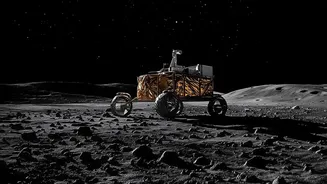
Finding and mapping these subterranean havens is a job for robots. Exploring dark, unknown, and potentially treacherous tunnels autonomously is a massive technological challenge. To solve it, space agencies and private companies are developing a new generation of robotic spelunkers. One leading concept from the European Space Agency (ESA) is a spherical robot called DAEDALUS. The 46-cm diameter probe is designed to be lowered into a pit, or 'skylight,' from a surface lander. Once on the cave floor, it would disconnect and roll autonomously, using LiDAR and stereo cameras to create detailed 3D maps of the interior. Other concepts involve teams of robots working together, with some exploring the surface entrance while a smaller scout rappels inside to begin the survey.
Mapping the Great Indoors
The primary mission for these rovers is reconnaissance. Their sensors will measure radiation levels to confirm the tubes are safe for humans. They will create high-resolution 3D maps to assess the size, shape, and structural integrity of the caverns. These robotic pioneers will also hunt for valuable resources, particularly water ice, which could be trapped in the eternally dark and cold sections of the caves. Discovering accessible water would be a game-changer, providing drinking water, breathable air, and rocket propellant for future settlers. Recent concepts backed by NASA even include laser-powered drones, tethered to a surface rover, that could hover and fly deep into these networks to gather data.
The Foundation for a Lunar City
The exploration of lava tubes is more than just a scientific curiosity; it's a critical step in the business of space settlement. Space agencies in the US, Europe, and China are all studying these structures as potential sites for permanent lunar bases. A confirmed, accessible lava tube could become the anchor for an entire off-world settlement. It could house not just astronaut habitats but also research laboratories, data centers, power generation facilities, and resource processing plants, all shielded from the harsh surface environment. By using these natural structures, the cost and complexity of establishing a long-term human presence on the Moon could be dramatically reduced, accelerating our journey to becoming a multi-planetary species.